

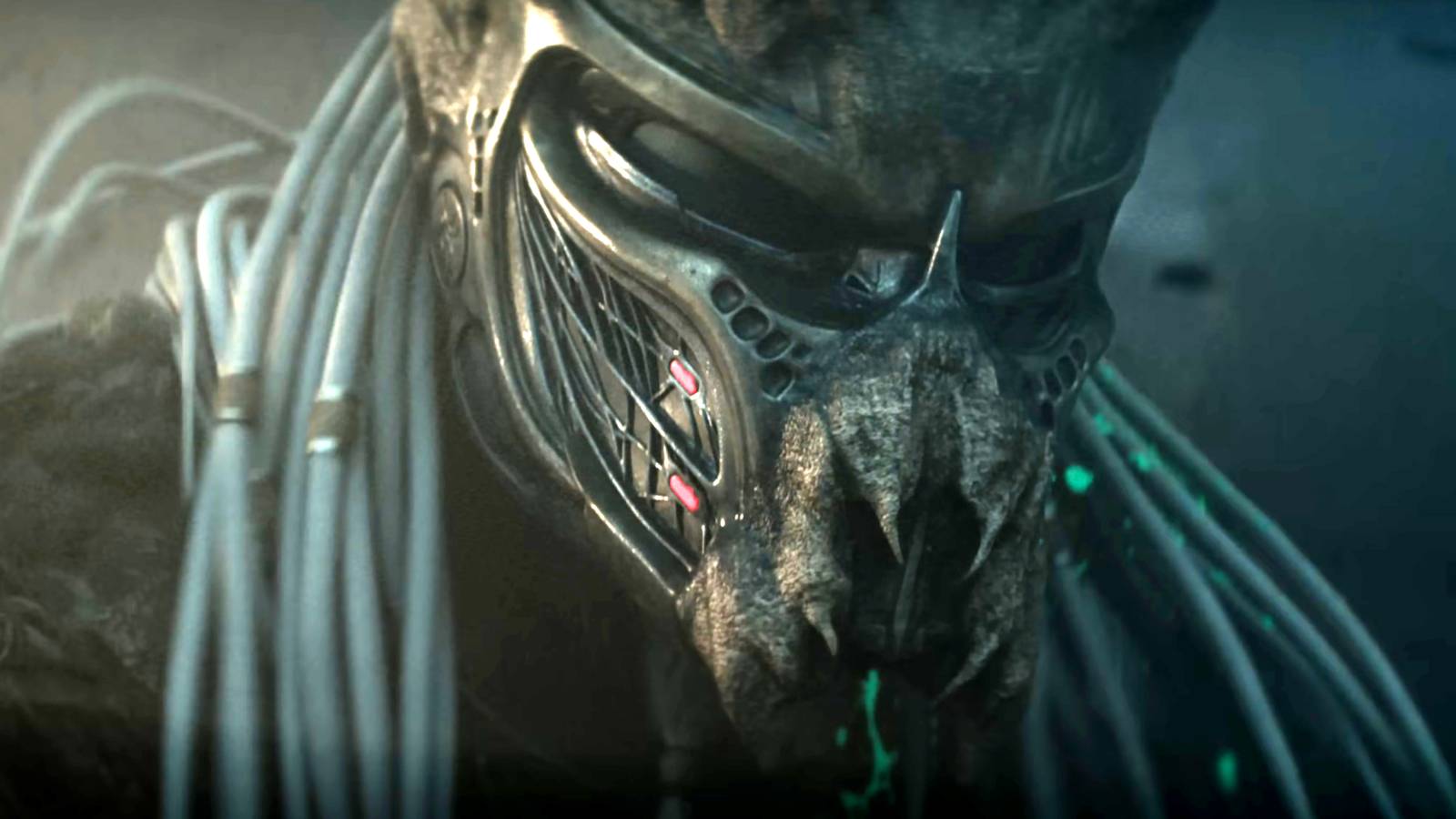
Warning: SPOILERS lie ahead for Predator: Badlands!Dek’s journey to prove himself worth resulted in the most emotional fight of Predator: Badlands, and that ending nearly looked very different. The latest outing from Dan Trachtenberg in the sci-fi franchise centered on the first-ever Yautja protagonist, Dek, who goes to the most dangerous planet in the galaxy, Genna, to conduct a hunt in an effort to prove himself as more than just the runt of his tribe.
After receiving help from Weyland-Yutani synth Thia to escape the planet, Predator: Badlands‘ ending sees her, Dek and the creature they’ve named Bud heading back to Yautja Prime with a demand to Dek’s father, Njohrr, to give him his cloaking device after bringing back a trophy. Having again been refused by his father, Dek kills both Njohrr’s bodyguards and Njohrr himself, utilizing a sandstorm made by his ship to help create his own form of cloaking.
Despite it delivering an epic ending to the proceedings, Dek and Njohrr’s fight in Predator: Badlands‘ ending originally played out much differently. In an interview with ScreenRant‘s Grant Hermanns on the heels of the movie’s release, Weta FX’s VFX Supervisor Sheldon Stopsack and Animation Supervisor Karl Rapley broke down the creation of the ending scene, with the latter revealing the initial plan for the sequence was “a short, little samurai standoff“:
Karl Rapley: Dek arrives, his father’s there, there was a quick exchange of blows, and Dek basically throws some sand from the ground, which reveals Father’s cloak. Then they just cross over, Father turns around, and his arm falls off. And it was cool!
As he went on to explain, the big reason for the change in the way the scene played out was that “the more we fleshed out the film, the more Father became the antagonist that was driving” it. The Animation Supervisor also recalled Trachtenberg looking at early test audience reactions to the movie and recognizing, “Oh, this needs to be a bigger moment“ and that he and the team “need to make more of a meal out of this.”
With this in mind, Weta set out to “make Father a badass so that Dek has to use all the skills that he’s learned” while being stuck on Genna, so that he could “take him down and outsmart him.” Praising the Predator: Badlands stunt team for having “came up with this great stunt choreography of Dek taking out the guards and fighting Father,” this then turned into said performers coming to Weta’s studio in Wellington to film on their motion-capture stage and “give [the scene] some scope“:
Karl Rapley: We were playing with the gags of the ship and the sand, like the jets kicking up the sand and revealing the cloak that way. While prevising that, we gave it some really wide shots to feel like this Western sundown moment. It was great; I loved that challenge.
Stopsack went on to recall being at that same test screening as Trachtenberg, where he was gauging the audience reaction and could tell there “was definitely an appetite to make it bigger in order to show the completion of Dek’s journey.” Interestingly, however, the VFX Supervisor revealed that the ending fight was “a reasonably late addition” to the studio’s body of work that they were work managing while making the latest Predator installment.
He went on to confess that there was a concern from the studio about taking on such a task that late into production, as it often comes with the risk of “not giving it enough time to look good,” something that most visual effects houses, particularly WETA, are “always very mindful of.” Stopsack explained that they have “honest conversations” with filmmakers about how much time they need going into a project to “put the right amount of time into the work,” as well as for filmmakers to “have [their] say in the process” to avoid films feeling like “just a rush job,” which “no one is happy with.”
Sheldon Stopsack: The trick here was that it was initially planned as a shorter, sharper beat, and it was filmed practically on a stage with set builds. At least in parts, as there was an awful lot of blue screen still, but there was plenty of photography to ground it. As the sequence grew, obviously, we didn’t have the benefit of going back onto that stage to film the missing pieces because the stage didn’t exist anymore. We were basically presented with the conundrum of having an awful lot of CG shots in there that we wanted to look real. You want to feel like you’re in that physical space, the same space where we originally had filmed.
With this “plausible” connection between the various filmed and early CG elements already there, Weta set about with the goal that “it just needed to look good.” Some of these elements included “a couple of shots of Father close up, coming out of his homestead” before he and Dek’s fight kicks off in the Predator: Badlands conclusion, as well as “the exact same shot” a few frames later, which was surprisingly “all digital.”
Despite wanting to keep the practical feel of the scene intact, however, Stopsack revealed that Weta “pretty much discarded most of the plate photography” for Njohrr’s homestead on Yautja Prime and instead used their own. Assuring it was still “consistent“, the VFX Supervisor explained that there were ultimately only “a handful of shots that still use plate elements,” so that the team could have “full control in terms of the lighting condition and everything that contributed to it.”
One element he says proved a more “daunting” feat to reckon with was the sandstorm created by Dek’s ship during the movie’s final fight scene. Describing it as a “genius idea” for the narrative of affecting Njohrr’s cloaking effect and “really give Dek the upper hand,” they then found themselves wondering how to pull it off, initially approaching it with “conservative ideas of how we could play it safe“:
Sheldon Stopsack: People have artistic opinions and give notes. We contemplated doing something more on the back end with volumetric VDBs and the compositing space and stuff like that. That was the initial idea, just to protect ourselves. But as we started working on that, one of our FX artists did an absolute remarkable proof of concept, which just looked so gritty and dirty and wild and energetic. It was like, “Okay, this looks absolutely stunning. We’ve got to do this. We’re going to commit to it.”
With their commitment to a “very convoluted approach” to how the sandstorm would look in the scene, the Weta team made “custom simulations per shot,” utilizing volumetric effects so that “everything was plausibly rendered together.” He even invited viewers to look closely in a revisit of the scene in which “you see the light fluctuation on Dek and Father” during the sandstorm, which he said “wasn’t us cheating a little bit in comp,” but instead a “physical, plausible approach.”
Despite their initial idea to go more conservative with the look of the fight, Stopsack revealed that Trachtenberg not only “embraced” their work on the scene, but even encouraged them to “make [the sandstorm] denser and dirtier,” finding he didn’t have much interest in actually seeing Dek and his father in the fight:
Sheldon Stopsack: It’s nice because it’s photographically incredibly satisfying for us. It’s an aesthetic that I admire Dan for choosing because there are people that often say, “I want to see my protagonist and antagonist. I want to see the clarity. I need to see the fight.” And Dan was like, “Nah, I don’t want to see them. I just want to see silhouettes. I just want to go all in on the mess.”
Much to Rapley’s early point in the conversation, Predator: Badlands‘ ending fight between Dek and Njohrr displays the former’s internationalization of his experiences in the film. The most notable is his use of the environment during the fight, both with throwing sand in his father’s face and the sandstorm itself, but also utilizing some of his Genna survival skills.
But even more than just pulling from his time on the so-called “death planet,” Dek and his father’s final fight also marks a proper full-circle ending to his story in killing off Njohrr much in the way he killed his brother, Kwei, at the start of the film. Having also successfully claimed his father’s cloaking device after his victory, the tease of Predator: Badlands‘ mid-credits scene pitting Dek against his mother and her tribe could see him continue to meld his experiences together for a unique fighting style.

As for the actual creation of the scene itself, it may not come as much of a surprise that Trachtenberg’s original vision for Predator: Badlands‘ ending was more of a straightforward samurai fight given he was just coming off of Predator: Killer of Killers, which notably had an entire chapter dedicated to a samurai character from the early 1600s. However, as is evident by each installment he makes, Trachtenberg not only clearly listened to early audience responses to reshape the ending, but also looked to his own work to deliver something fresh for franchise fans.
Be sure to dive into some of our other Predator: Badlands coverage with:

- Release Date
-
November 5, 2025
- Runtime
-
107 minutes
- Director
-
Dan Trachtenberg
- Writers
-
Dan Trachtenberg, Patrick Aison, John Thomas, Jim Thomas
- Producers
-
Brent O’Connor, John Davis, Marc Toberoff, Dan Trachtenberg, Ben Rosenblatt
-

Elle Fanning
Thia / Tessa
-

Dimitrius Schuster-Koloamatangi
Dek / Father
