

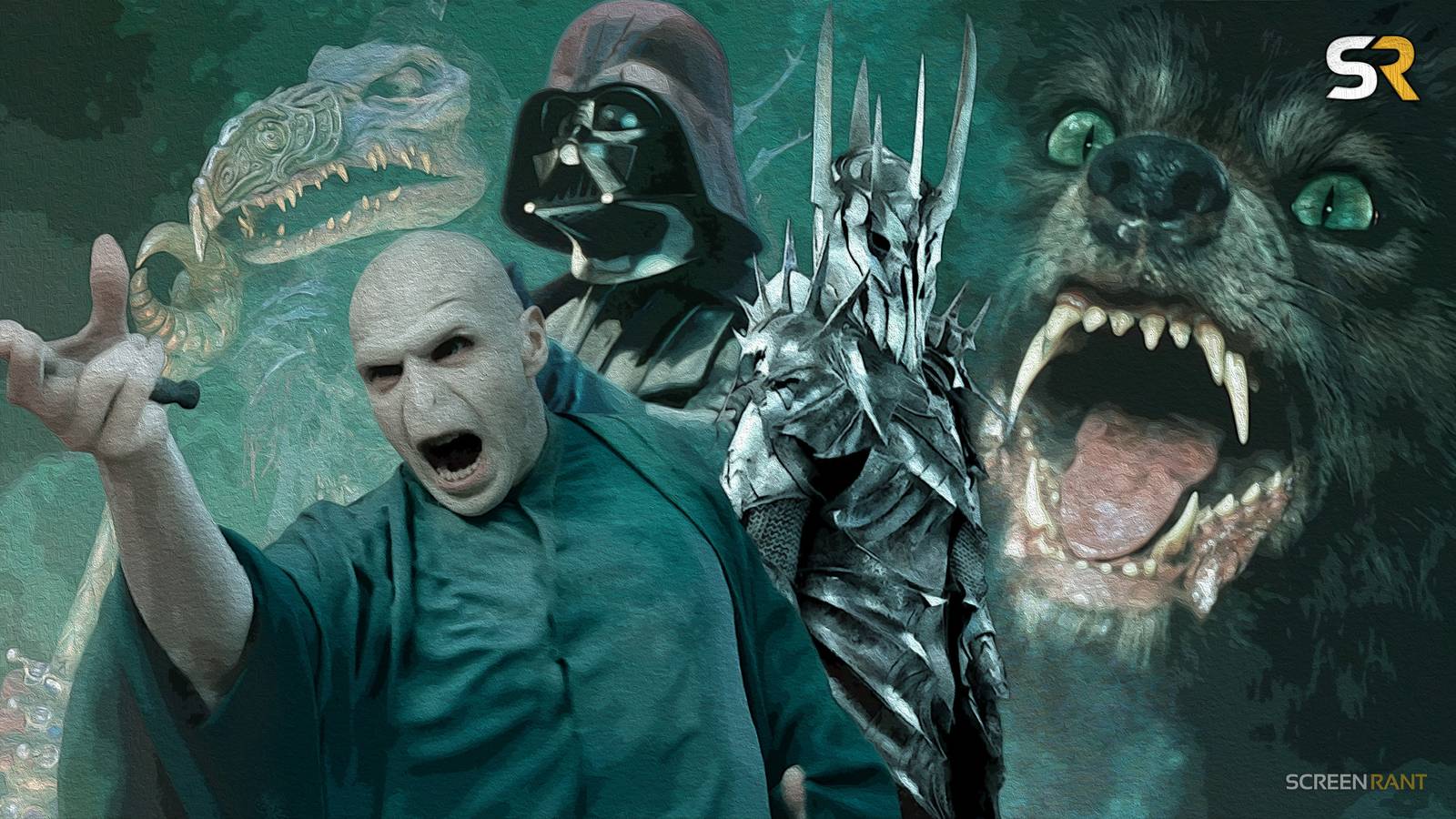
Fantasy villains are built differently. Superhero movie bad guys usually want revenge, power, or world domination, but fantasy movies get weirder, darker, and honestly way more traumatic. These are the villains that haunted childhoods, fueled internet obsession, and somehow made audiences afraid of witches, goblins, giant flaming eyes, and things hiding in the woods long after the credits rolled.
And while we’re being honest: fantasy movies used to absolutely terrorize children in ways modern family entertainment rarely even attempts anymore. Entire generations are still emotionally recovering from face-peeling witches, soul-stealing sorcerers, nightmare wolves, and giant puppet creatures that looked like they crawled out of another dimension. Somehow, we all survived it and became obsessed with these characters anyway.
What separates great fantasy villains from standard blockbuster bad guys is mythology. The best ones feel bigger than the movies themselves. Some barely even appear onscreen yet dominate every scene through sheer presence alone. Others seduce audiences into rooting for them despite doing objectively horrifying things. And the truly legendary ones permanently rewired pop culture forever.
From Disney manipulators to dark lords who became shorthand for evil itself, these fantasy villains stand above the rest. And yes—before the comments section erupts—Maleficent, Ursula, and a handful of other all-timers didn’t make the cut. Consider this your formal acknowledgment that the debate is very much open.
10
Jafar — Aladdin
Jafar remains one of Disney’s most entertaining villains because he understands the power of presentation. Everything about him is theatrical: the voice, the towering robes, the cobra staff, and the permanent expression of someone moments away from completely losing his patience with everyone around him.
What makes him so effective is how quickly his manipulation escalates into outright madness. He begins Aladdin as a political schemer weaponizing palace protocol and psychological games before transforming into an all-powerful sorcerer consumed by ego. The moment he towers over Agrabah as a giant cobra—hissing at a hero he’s already beaten — is pure unhinged villainy at its most committed. Nightmare fuel for kids, iconic cinema for everybody else.
9
The Skeksis — The Dark Crystal

The Skeksis somehow remain more disturbing than most modern CGI villains decades later. Their rotting bird-like bodies, twitchy movements, screeching voices, and filthy royal costumes make them feel genuinely diseased in a way fantasy movies rarely attempt anymore.
What’s fascinating is how differently they hit as adults. As kids, audiences feared them because they looked horrifying—and the scene where they drain the life from a captured Gelfling, visibly aging and withering before the audience’s eyes, is still deeply uncomfortable to watch.
Revisiting The Dark Crystal later in life reveals something worse: the Skeksis are parasites desperately draining the world around them to prolong their own existence. They’re grotesque embodiments of greed, decay, and corruption hiding beneath royal pageantry. Jim Henson really looked at children and said, “good luck sleeping tonight.”
8
The Grand High Witch — The Witches

Entire generations are still recovering from Anjelica Huston peeling off her human face in The Witches. The Grand High Witch works because she weaponizes elegance before revealing pure nightmare fuel underneath.
Huston plays her with just enough glamour and theatricality to lull audiences into a false sense of security—the conference room scene, with its polished performance and simmering menace, plays almost like a corporate thriller before the masks literally come off.
And that’s the genius of the character: she doesn’t need armies or giant fantasy battles to feel dangerous. She turns ordinary spaces into hunting grounds and transforms childhood fears into body horror. Even now, decades later, that reveal scene still feels genuinely unsettling.
7
Shang Tsung — Mortal Kombat

Nobody in the 1990s fantasy-action cinema looked like they were enjoying evil quite as much as Shang Tsung. Cary-Hiroyuki Tagawa completely dominates Mortal Kombat with a performance so charismatic that he essentially became inseparable from the character forever. Every line delivery feels theatrical in the best possible way, balancing supernatural menace with the confidence of someone who already knows everyone else in the room is doomed.
A concept rooted in some of humanity’s oldest and most primal fears: the idea that death isn’t just an ending but a theft.
What elevates Shang Tsung beyond standard action-movie villainy is how mythologically dark his power actually is. He’s literally consuming his enemies’ identities, absorbing their souls to sustain his own existence. That’s a concept rooted in some of humanity’s oldest and most primal fears: the idea that death isn’t just an ending but a theft.
The character taps into something genuinely ancient, and Tagawa’s performance gives it the theatrical weight it deserves. Mortal Kombat nostalgia may be bigger now than it’s been in years, but Shang Tsung has always earned his place on lists like this.
6
The Pale Man — Pan’s Labyrinth

Few fantasy villains have ever accomplished more with less screen time than the Pale Man. Guillermo del Toro created one of modern cinema’s most unforgettable nightmare creatures using almost complete silence. The sagging skin, eyes hidden in the palms, and grotesque dining-table imagery instantly burned themselves into pop culture the moment audiences saw them.
What makes the Pale Man especially terrifying is that he feels ancient and symbolic rather than simply monstrous. He represents cruelty sitting comfortably at the head of a feast while others suffer around him. Fantasy movies thrive when they tap into folklore and primal fears, and the Pale Man feels like the kind of nightmare humanity has been warning each other about for centuries.
5
The Gmork — The NeverEnding Story

The Gmork is pure existential dread disguised as a giant wolf. Even now, decades later, the creature remains genuinely frightening thanks to the glowing eyes, skeletal design, and snarling practical effects work that still holds up shockingly well.
But the real reason The Gmork lingers in people’s minds is the philosophy behind the monster itself. This isn’t just a predator hunting the hero. The Gmork represents hopelessness, nihilism, and the death of imagination itself.
The Gmork is pure existential dread disguised as a giant wolf.
His monologue—delivered with quiet, almost satisfied menace—about people without hope being easier to control remains one of the darkest moments ever put into a fantasy movie supposedly aimed at children. Paradoxically, it hits even harder as an adult.
4
Jareth the Goblin King — Labyrinth

No fantasy villain has aged into internet obsession quite like David Bowie’s Jareth. Part glam-rock icon, part gothic chaos demon, Jareth remains one of the strangest and most fascinating villains fantasy cinema has ever produced. Bowie plays him with complete commitment, balancing seduction, arrogance, emotional manipulation, and genuine menace in a way almost nobody else could pull off. The crystal ball scene alone—Jareth conjuring impossible magic with casual elegance while making it feel like a gift rather than a threat—captures exactly why this character has never been replicated.
What makes Jareth so iconic is that audiences almost want him to win. He disguises danger behind music, glitter, beauty, and charisma, turning Labyrinth into a hypnotic fantasy fever dream people still obsess over decades later. There’s a reason the Goblin King remains one of the internet’s favorite cult-movie villains: nobody has ever really replicated this exact kind of magic again.
3
Voldemort — Harry Potter and the Deathly Hallows – Part 2

An entire generation grew up fearing Voldemort before they even fully saw him. That buildup—spread across years of films and books—transformed him into something much larger than a standard blockbuster villain. Across the Harry Potter franchise, Voldemort became a mythological shadow hanging over the wizarding world itself, a name so terrifying people refused to say it aloud.
By the time Ralph Fiennes delivers the character’s full destructive power in Deathly Hallows – Part 2, that weight makes every scene feel genuinely operatic. Fiennes elevated that mythology with a performance that felt both calculating and completely unstable.
The snake-like face, whispery delivery, and explosive unpredictability made Voldemort feel genuinely dangerous in a franchise built around fantasy spectacle. More importantly, he represented something deeper than magical power: a man so terrified of mortality that he willingly destroyed his own humanity trying to escape it.
2
Sauron — The Lord of the Rings: The Return of the King

Sauron barely physically appears in The Lord of the Rings trilogy, yet somehow feels larger than almost every villain in movie history. That’s what makes him brilliant. Peter Jackson transformed Sauron into an overwhelming presence hanging over every corner of Middle-earth. The giant flaming eye became one of fantasy cinema’s most iconic images, symbolizing corruption, paranoia, and unstoppable power without needing endless dialogue or exposition.
The scale of The Lord of the Rings only amplified the fear surrounding him. Entire civilizations collapsed under Sauron’s influence. Massive armies marched in his name. The entire plot of a 12-hour fantasy epic essentially boils down to one terrifying objective: don’t let him see you. Very few villains have ever felt this mythic.
1
Darth Vader — Star Wars: Episode VI – Return of the Jedi

Yes, Star Wars is science fiction. But strip away the spaceships and Darth Vader is something much older than that. At its core, Star Wars is mythology. George Lucas built it explicitly on Joseph Campbell’s hero’s journey—the same storytelling framework underpinning centuries of folklore, legend, and fantasy. The Force is magic by another name. The Empire is a dark kingdom. And Darth Vader is a dark knight, armored and corrupted, serving an evil emperor while wielding supernatural power.
When it comes to cinematic villains, nobody casts a larger shadow.
The science fiction dressing is surface level. Underneath, this is fantasy in its most archetypal form. And when it comes to cinematic villains, nobody casts a larger shadow. The breathing alone became legendary. Add the black armor, towering silhouette, James Earl Jones’ voice, and tragic backstory, and Vader transformed into something much bigger than a movie character.
What truly separates Darth Vader from almost every other fantasy villain is emotional complexity. Beneath the fear and destruction was tragedy, regret, rage, and ultimately redemption. Nearly 50 years later, one mechanical breath is still enough to stop an audience cold.

- Release Date
-
May 25, 1983
- Runtime
-
132 minutes
- Director
-
Richard Marquand
