

Of all the many storytelling genres, high fantasy presents one of the biggest challenges when it comes to adapting a story for the screen. Unlike other, cozier forms of fantasy, the high fantasy genre is characterized by its epic scale. Stories are set in an alternative world that may look completely different to the one we know, they are likely to involve many characters, and large-scale events like battles often happen. That said, when adapted well, high fantasy book masterpieces often become cinematic successes that stand the test of time.
There are few high fantasy movies better than The Lord of the Rings trilogy, which is the only fantasy franchise without a single bad movie. It is often considered to be the pinnacle of achievement for the genre, but this is a difficult goal to reach when making a TV series. Even some of the best fantasy TV shows of all time can struggle with pacing between seasons, and choosing which parts of the story to include. One of the best is His Dark Materials, because it is a faithful adaptation of Philip Pullman’s high fantasy trilogy.
The best high fantasy books are immersive and rich in worldbuilding, but it is easy to understand why adapting their stories for the screen could be a daunting task. That said, that does not mean that an attempt should not be made. Game of Thrones changed TV forever by showing what could be done with an enormous special effects budget, but it also taught writers what not to do, and an adaptation of one of these high fantasy books can learn from Game of Thrones‘ mistakes.
The First Law Trilogy
Joe Abercrombie
Joe Abercrombie’s brutal First Law trilogy belongs to the same fantasy subgenre as Game of Thrones, which is known as grimdark. Great grimdark fantasies have a violent tone and often lack the traditional happy ending that is commonly associated with the genre. This is a genre that Abercrombie excels in, and this trilogy has often been compared to George R. R. Martin’s signature fantasy series as they share a cynical tone that reflects on the cyclical nature of war and political scheming.
The First Law trilogy focuses on three political powers; a war-torn union, an oppressive empire, and more remote tribes. The story is told through the eyes of three main characters, who would all translate well to the screen. The Northern barbarian Logen Ninefingers would need a physically imposing presence. Sand dan Glotka, the war hero turned torturer, must be played by a character actor who is skilled at playing complex characters with warring emotions. The arrogant nobleman and fencer Jezal dan Luther could offer the opportunity for a newer actor to prove he can handle a physically demanding role.
Abercrombie’s work has not yet been adapted for the screen, and what makes this so tragic is how close fans came to getting a TV show. When a movie adaptation of his standalone book Best Served Cold was canceled, this killed the next major fantasy universe and Game of Thrones replacement. However, a First Law trilogy TV show could still happen one day, and this could give potential new fans more of a chance to discover Joe Abercrombie’s bleak but compelling world.
The Earthsea Cycle
Ursula K. Le Guin

Ursula K. Le Guin’s Earthsea fantasy series is better than Harry Potter despite initially appearing to have a similar plot, and Earthsea was published first, with the first book in the series being published in 1968. It was originally intended to be a standalone book, but Le Guin continued the story after writing the second to tie up the loose ends lift in the first. With J.K. Rowling’s political views causing many former Harry Potter fans to boycott her work, an adaptation of Earthsea would offer the perfect opportunity for a similar story but from a less controversial author.
|
The Earthsea books in publishing order |
|
|---|---|
|
Title |
Date |
|
A Wizard of Earthsea |
1968 |
|
The Tombs of Atuan |
1971 |
|
The Farthest Shore |
1972 |
|
Tehanu |
1990 |
|
Tales From Earthsea |
2001 |
|
The Other Wind |
2001 |
Earthsea has technically been adapted for TV, but this took the form of a three-hour movie that was released in two parts and earned a 52% positive audience rating on Rotten Tomatoes. This does not do Le Guin’s series justice, and it deserves a high-budget adaptation that remains faithful to the story. The Earthsea Cycle follows Ged, who attends a school for magic but finds himself fighting an enemy that he did not expect. The books are relatively short, but contain an intricate landscape of islands and oceans that could be visually stunning onscreen.
Poison
Chris Wooding

Poison is a standalone young adult high fantasy novel that has been criminally underrated. The story begins with a typical fantasy set-up, before evolving into something mind-bending. When the self-named main character, Poison, discovers that her baby sister has been taken by the Phaeries, who have left a creepy changeling in her place, she sets out on a quest to find them and demand her sister back. The story moves through horror and whimsy, but becomes more complex, eventually feeling like The Matrix if the sci-fi masterpiece had been written as a fantasy.
While the book is short compared to other fantasy novels, it would be a mistake to try and make a Poison adaptation with a low budget. The many bizarre characters, from the enormous shark-toothed Bone-Witch to the ethereal Pariasa, would require an excellent character design team to bring them to life, and the story is deceptively complicated and philosophical. Poison visits multiple different realms, many of which are on the brink of war, and one of the more disturbing scenes would involve a significant budget for gore.
The Liveship Traders Trilogy
Robin Hobb

The Liveship Traders trilogy feels like Pirates of the Caribbean and Game of Thrones, with much of the story taking place on the sea and in pirate towns. The story follows the wealthy and privileged Vestrit trading family, who are capable of traveling on the acid river of the Rain Wilds because they own a rare Liveship. These are ships with living figureheads who become characters in their own right. When pirates take the Liveship Vivacia hostage, this sparks a chain of events that will change the world forever by reintroducing dragons.
The series is extremely violent and disturbing at times, including a slavery plotline and sexual assaults. However, while Game of Thrones has aged badly for its gratuitous approach to violence, the scenes in The Liveship Traders trilogy are treated with the appropriate gravity and horror. The series is full of well-written female characters, depicts many different kinds of strength in both male and female characters, and could be imagined on an epic scale. If the hypothetical Liveship Traders adaptation was successful, the dragon-focused sequel trilogy could also be adapted.
The Axis Trilogy
Sara Douglass

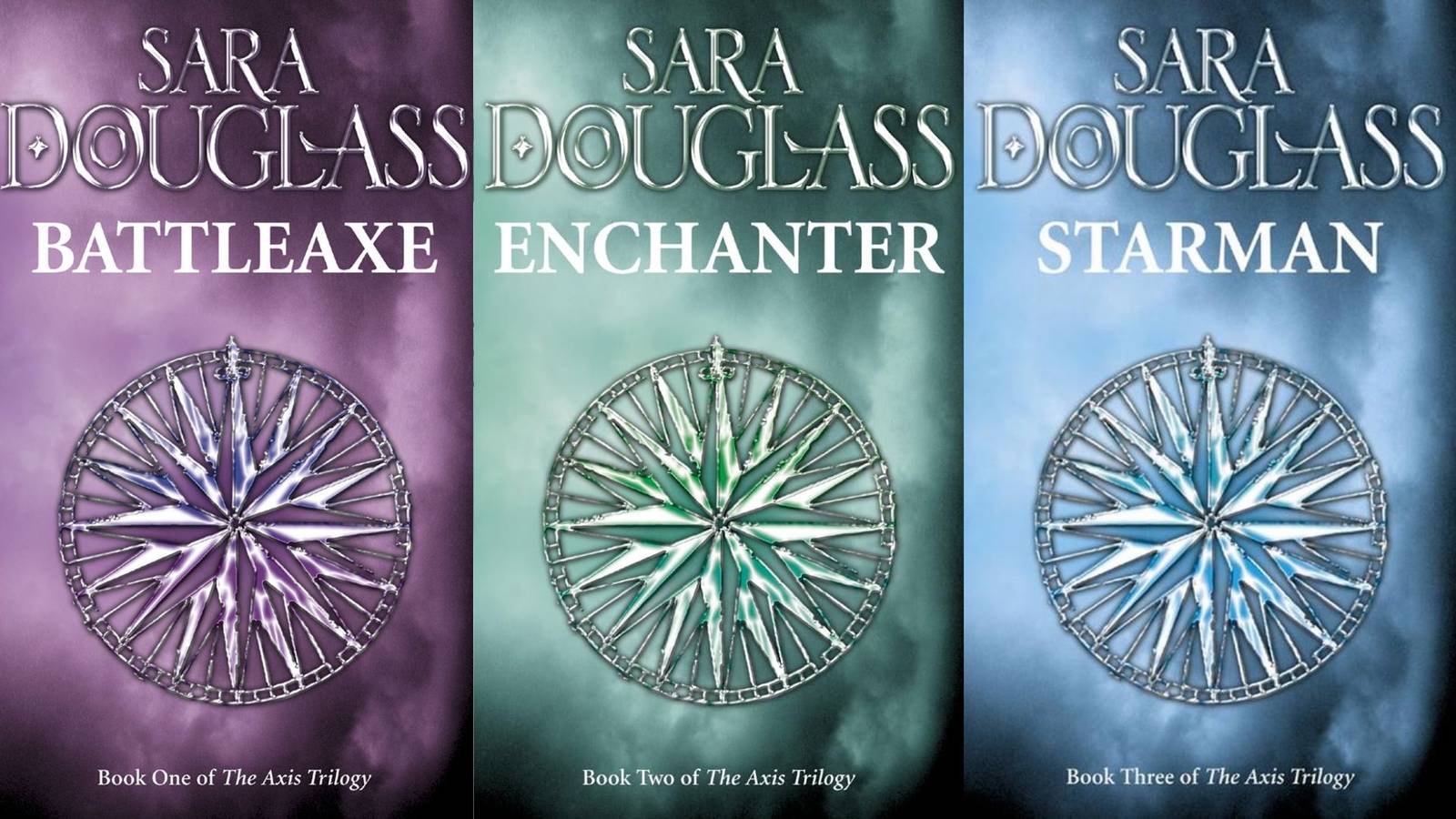
Many of Sara Douglass’ books have been compared to Game of Thrones for their political intrigue and the way the central family line resembles Jaime and Cersei in the most disturbing way. However, the Axis trilogy is extremely distinctive in its own right, centering on three main races living in a divided kingdom where atrocities are committed. These are the winged and arrogant Icarii, the humans (Acharites,) and the horned Avar, who live in the forest. The epic story spans years and covers the struggle for freedom under an oppressive regime.
Sara Douglass won the Aurealis Award for the second and third books in the trilogy, Enchanter and Starman, in 1996.
Both the Axis trilogy and its sequel, the Wayfarer Redemption trilogy, are detailed, with sprawling worlds, cultures, and mythologies that deserve a TV adaptation that will explore them fully. The story’s lore is extensive and Douglass has expanded on the central world of Tencendor in several other books. With so few high fantasy series being given the chance to excel, with early cancelations and major story changes, a faithful adaptation of the Axis trilogy could be a vivid and boundary-pushing show that will attract new viewers and keep them talking about it.
The Kingkiller Chronicle
Patrick Rothfuss

Currently, Patrick Rothfuss’ Kingkiller Chronicle trilogy contains just two books and a spinoff, but these provide plenty of material to adapt, as the worldbuilding is so detailed. The Kingkiller Chronicle stands out among other high fantasy stories for the way Rothfuss reimagines ordinary things, presenting magic as science and introducing a culture which communicates emotion through sign language rather than facial expression. The books take place in two different timelines, following the musician Kvothe, who is hiding from his past life while telling his story to a biographer.
Kvothe’s fun adventures and chemistry with the other characters must be central to an adaptation, as this allows the series’ chilling central mystery to be a truly disturbing contrast. With this driving Kvothe’s central quest, it would be the perfect opportunity for a great writing team to strike the balance between cozy and epic. The Lord of the Rings did this perfectly, but this balance has rarely been achieved by a TV series. The characters in Rothfuss’ works deserve to be brought to life, and as Kvothe is not always likable, this would present an interesting writing challenge.
The Old Kingdom Trilogy
Garth Nix

Garth Nix’s Old Kingdom young adult trilogy is defined by its use of both necromancy and music as a central plotline, with a “chosen one” style character whose job it is to lay the dead to rest. The series has sometimes been compared to The Witcher with a sword-wielding female lead who is the kingdom’s best defense against the army of the dead. That said, the story avoids many of the typical tropes associated with “chosen one” archetypes, with the overarching theme allowing the characters to choose the life path that feels right.
This approach to destiny makes a refreshing change for the fantasy genre that deserves to be represented onscreen, and there are some standout sequences in the books that would be defining visual moments in any fantasy TV show. These include sentient magic-fuelled planes made of paper, a dangerous library within a clairvoyant mountain community, and two of the best side characters in any fantasy series: a constantly-bickering supernatural cat and dog.
