

The Far Side is best known for finding bizarre humor in everyday encounters, animal behavior, and other aspects of life. Gary Larson also looked toward history, drawing inspiration from real people and events that carried their own recognizable stories. His comics approached these subjects from a unique angle, substituting accuracy for the kind of absurdity only Larson could conjure.
Whether a strip draws on a notorious expedition, a landmark speech, or a renowned battle, the historical connection gives the joke extra texture. These comics are also often inclusive, as Larson bends recognizable details toward an unexpected punchline, letting the joke work on its own while rewarding readers who recognize the real-world reference.
10
Bugeyed Bingham’s Bad Day at Bunker Hill
This comic takes its humor from a famous story associated with the American Revolution, placing a British soldier named Charles Bingham in the middle of the 1775 battle at Bunker Hill. Unfortunately for him, an enemy instruction about waiting until the enemy is close enough to identify becomes a particularly unfortunate detail.
The joke depends on Bingham’s conspicuously large eyes, which make him an ironic exception to the military advice. His exaggerated features undermine the caution, making him easy to spot even before the troops draw near. This puts his life at far more risk than his fellow soldiers, and the anxiety drawn from that realization is hilariously apparent.
9
The Donner Party Snow Dome

This strip presents a glass snow dome sitting on a desk, with miniature pioneers gathered beneath snow-covered mountains. Its caption calls the object “the ever-popular Donner Party snow dome,” depicting a grim chapter of American westward migration as an absurd novelty item. The desk setting also contributes to the eerily regular atmosphere surrounding the souvenir.
The historical reference is the Donner Party, a group of emigrants who became trapped in the Sierra Nevada during the winter between 1846 and 1847. Cut off by deep snow, the travelers endured starvation and desperate conditions, with some survivors resorting to cannibalism. Larson’s joke leans on how jarringly that ordeal contrasts with a decorative keepsake.
8
Lincoln’s Duck Joke at Gettysburg

This comic imagines Abraham Lincoln preparing to deliver the Gettysburg Address before a gathered audience, but his speech opens with a startling line. Alongside its solemn rhetoric, he begins with a barroom gag about a bartender objecting that something is not a duck, followed by a cue to pause for the expected laughter.
The gag rests on a sharp clash between the gravity of the occasion and the speaker’s lowbrow attempt at comedy. Lincoln delivered the real address on November 19, 1863, at the dedication of a cemetery for Union soldiers killed at Gettysburg, but Larson’s imagined detour makes the revered ceremony feel comically awkward.
7
Marie Antoinette’s Last-Ditch Effort to Save Her Head

This comic depicts the former French queen Marie Antoinette standing on the guillotine platform with an executioner behind her and an angry crowd gathered below. In a revision of her famous statement to let the populace eat cake, she calls out that she meant to offer cake and ice cream, a meaningless addition that further exaggerates her ignorance.
Marie Antoinette was executed in Paris on October 16, 1793, during the French Revolution, after the monarchy collapsed and the new republic tried the former queen for treason. The cartoon draws on her already humorous attempt to appease the crowd with dessert, fully illustrating the scene and conveying the hilarity of the situation
6
The Trojan Horse’s Bathroom Break

This strip focuses on the famous Greek warriors concealed inside the wooden Trojan Horse, waiting for darkness before launching their historical attack on the city of Troy. One of them, Cornelius, has an urgent need to relieve himself, but his companion dismisses the complaint and tells him to endure it until nightfall.
The scene pokes fun at the unspoken practical problems behind the story of the Trojan Horse. Greek warriors may be prepared to wait for the signal to attack, but staying tucked away inside a wooden horse is a lot less manageable when nature calls. The inclusion adds an unexpectedly mundane side to the story that makes for an amusing scenario.
5
Santa Arrives in the New World

This comic imagines Santa Claus arriving in the Americas aboard a wooden sailing ship, with the familiar gift-bringer standing high above the deck. Spotting land, he calls out “Land ho ho ho!” combining a traditional sailor’s cry with Santa’s trademark laugh, alluding to the vibe and reference the strip aims to capture.
The joke points toward Christopher Columbus’s 1492 voyage, when his expedition successfully crossed the Atlantic and reached a Caribbean island inhabited by Indigenous people. Larson instead places Santa in a much less familiar setting of European exploration, imagining the holiday figure arriving at a moment tied to Columbus’s historic Atlantic crossing.
4
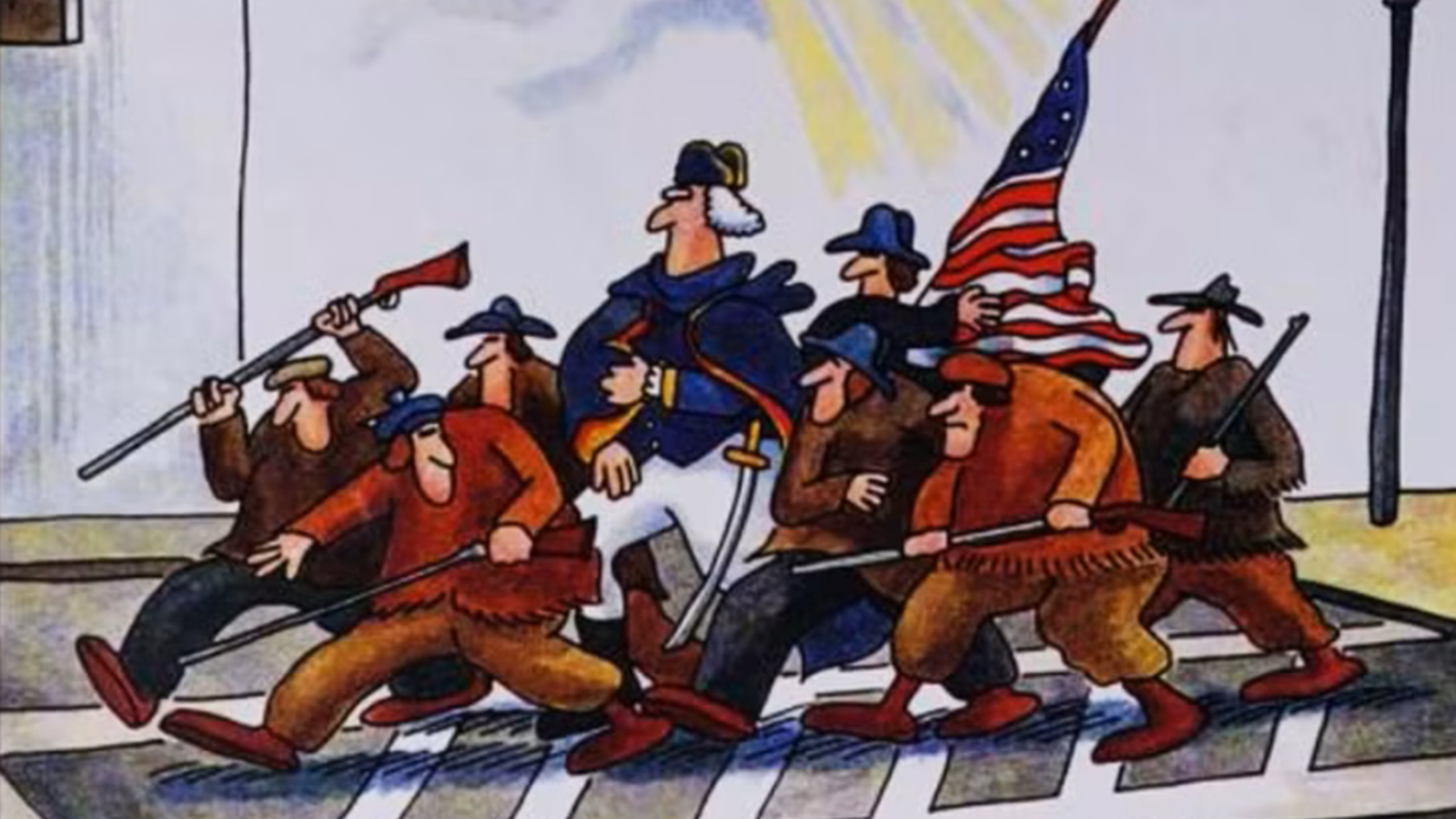
Washington Crosses the Street

This comic reimagines a famous scene from the American Revolution, replacing the icy Delaware River with an ordinary city street. It illustrates a tightly packed group of Continental soldiers crossing at a pedestrian crossing, still carrying their muskets and flag. This particular strip relies heavily on the reader’s recognition of the famous artwork.
The reference is Emanuel Leutze’s 1851 painting Washington Crossing the Delaware, which became an iconic image of the struggle for American independence. It depicts Washington leading troops across the river on Christmas night in 1776 before the surprise attack on Hessian forces at Trenton. Larson’s substitute wittily trivializes the moment by transforming it into an overly dramatic road crossing.
3
The Alamo Souvenir Stand

This strip places a souvenir seller beneath a line of Texan defenders firing from the Alamo’s walls. His table displays mugs and shirts, including two boasting, “I Kicked Santa Anna’s butt at the Alamo.” As the battle continues overhead, the vendor cheerfully sells memorabilia celebrating the very fight raging around him.
The historical setting is the 1836 Battle of the Alamo, when Mexican troops under General Antonio López de Santa Anna besieged the mission in San Antonio. After thirteen days, his forces launched a final assault on March 6, killing the garrison. The gag employs dark humor in packaging a deadly event as boastful tourist merchandise.
2
Moon Landing Gone Wrong

This comic illustrates a mishap following America’s first crewed Moon landing, with two astronauts departing while a third remains stranded on the lunar surface. A note left behind offers him little comfort, and the scene plays on the absurdly casual way the departing crew seems to handle abandoning a colleague.
The actual Apollo 11 mission reached the Moon in July 1969, with Neil Armstrong and Buzz Aldrin walking on the surface while Michael Collins stayed in lunar orbit aboard Columbia. All three astronauts returned safely to Earth, so Larson’s stranded explorer represents an alternate timeline that pokes at the near-mythic image of perfect spaceflight.
1
We the People or Us the People?

This comic imagines a group of powdered-wigged American founders gathered around a table, debating a tiny but consequential wording choice. One man pauses over his parchment to ask whether the Constitution should begin with “us the people” or “we the people.” The air of seriousness around the table supplies a good portion of the cartoon’s humor.
The joke references the opening of the U.S. Constitution’s Preamble, whose first words are “We the People of the United States.” That phrase establishes the people as the source of the government’s authority, but Larson focuses on the small but relevant grammatical distinction instead of the passage’s sweeping purpose.
