

Spoiler warning: Major endings and character deaths are discussed below.
War movies can make an audience flinch without making anyone cry. Explosions are loud, battle scenes are terrifying, and a convincing death can stop a viewer in their tracks. But the worst heartbreak often arrives afterward, when someone has to live with what happened—or when a person who should have made it home never gets the chance.
It’s a distinction worth making. The greatest 20th-century war movies aren’t automatically the most upsetting, and the bloodiest films don’t necessarily leave the deepest emotional scars. Some offer the consolation of a successful mission. Others end with a victory that feels almost impossible to celebrate.
The movies below find their devastation in different places. There’s the loss of childhood, the destruction of an entire community, and the crushing realization that surviving a war doesn’t mean escaping it. A few are built around enormous historical catastrophes; others reduce those events to one face or one terrible decision.
This ranking weighs emotional performances, specific losses, and the way each film’s final moments reshape everything that came before. It’s not a competition to see which war was worse, nor a test of military realism. An ending that hurts because we’ve come to love the characters can be more affecting than the biggest battle ever filmed.
Some of these selections also belong among cinema’s most hopeless war stories. The difference here is that hope isn’t disqualifying. Saving Private Ryan, for instance, believes sacrifice can have meaning. That belief may be precisely what makes its ending so difficult to watch.
10
Paths Of Glory (1957)
Stanley Kubrick’s Paths of Glory contains relatively little combat compared with its reputation as one of the great anti-war films. What it has instead is something more infuriating: three French soldiers ordered to face execution for supposed cowardice after a disastrous World War I attack. Their deaths become a matter of military convenience.
Kirk Douglas gives Colonel Dax a furious dignity as he tries to defend the men, knowing the proceedings are designed to protect the officers who sent them into an impossible situation. Kubrick has no need to exaggerate the injustice. He lets the orderly mechanics of the court-martial do the damage.
The final scene, in which exhausted soldiers listen to a young German woman sing, offers human recognition after a film full of cruelty. It’s a standout even among war movies that rival Apocalypse Now, although its emotional effect is more restrained than the intimate tragedies higher on this list.
9
Gallipoli (1981)

For much of Peter Weir’s Gallipoli, war seems almost abstract. Archy (Mark Lee) and Frank (Mel Gibson) are young Australian runners with promising futures, and the film gives them time to be friends before sending them into the First World War. Their easy camaraderie makes the destination feel increasingly unbearable.
When the men arrive at Gallipoli, the military machinery takes over. Frank races to stop an attack that should never happen, while Archy prepares to cross open ground under enemy fire. The tragedy isn’t that the audience fails to understand what’s coming. It’s that everyone who matters understands too late.
That final image of Archy mid-stride is devastating because running was once his joy. Weir turns the boy’s greatest gift into the last thing we see him do. Few war films make the waste of a young life feel quite so immediate.
8
Letters From Iwo Jima (2006)

Clint Eastwood’s Letters from Iwo Jima approaches a familiar World War II battle from the Japanese side, replacing the usual American victory narrative with the fears of men who know they are unlikely to return home. The letters they write are ordinary, sometimes awkward expressions of affection. That’s exactly why they matter.
Ken Watanabe lends General Kuribayashi a weary intelligence, but the film’s emotional center also belongs to soldiers such as Saigo (Kazunari Ninomiya), who longs for his wife and the child he has yet to meet. Their private hopes survive even as the military situation collapses around them.
Eastwood’s best movies of the last 30 years often find power in difficult moral choices. Here, the quiet moments hit hardest. A letter is a promise of communication that may never reach its destination, and the film refuses to let the men become anonymous casualties.
7
All Quiet On The Western Front (2022)

Edward Berger’s adaptation of Erich Maria Remarque’s novel begins with young German recruits being sold a vision of patriotic glory. The machinery of World War I dismantles that fantasy almost immediately. Even the uniforms have been recycled from dead soldiers, a cruel detail that tells us how replaceable these boys already are.
Felix Kammerer’s Paul Bäumer gradually loses the enthusiasm that sent him to the front. An encounter with a dying French soldier in a shell crater forces him to confront the humanity of the people he’s been trained to kill. For a moment, war shrinks to two frightened men and a mistake that cannot be undone.
The film’s ending, set against the imminent armistice, is especially punishing. Every needless death feels worse when peace is only minutes away. Its relentless bleakness is formidable, although the stories above develop an even more personal bond between the audience and those facing loss.
6
The Pianist (2002)

Roman Polanski’s The Pianist follows Polish Jewish musician Władysław Szpilman (Adrien Brody) as Nazi persecution destroys his family and the Warsaw he knows. His survival never feels triumphant. He spends much of the film isolated, hungry, and terrified of making the smallest sound.
Brody’s performance is devastating partly because Szpilman’s personality seems to recede under the strain of staying alive. Music, once central to his identity, becomes something he can scarcely afford to think about. When a German officer finally asks him to play piano, it is an act of expression after a long period of enforced silence.
There is relief in knowing Szpilman survives, but the film gives the audience no reason to confuse survival with restoration. The empty city and the people who will never return remain its most painful images. It ranks below the top five because its distance and restraint are also part of its design.
5
The Deer Hunter (1978)

The Deer Hunter understands that the most terrible thing about war may be what happens after the fighting ends. Michael Cimino spends considerable time with three Pennsylvania friends before they leave for Vietnam. Their weddings, jobs, and easy familiarity make the world they’re about to lose feel complete.
Robert De Niro’s Michael comes home altered, while Christopher Walken’s Nick is lost in a much more final way. The Russian roulette sequences are horrifying, but the film’s deepest wound is the distance between the men who once knew each other effortlessly. Returning home does not bring that earlier life back.
Cimino’s long, sometimes uncomfortable pacing pays off in the closing gathering. The people left behind try to inhabit the same room despite knowing that their community has changed forever. It’s devastating because the damage spreads well beyond the battlefield, affecting even those who never went to Vietnam.
4
Saving Private Ryan (1998)

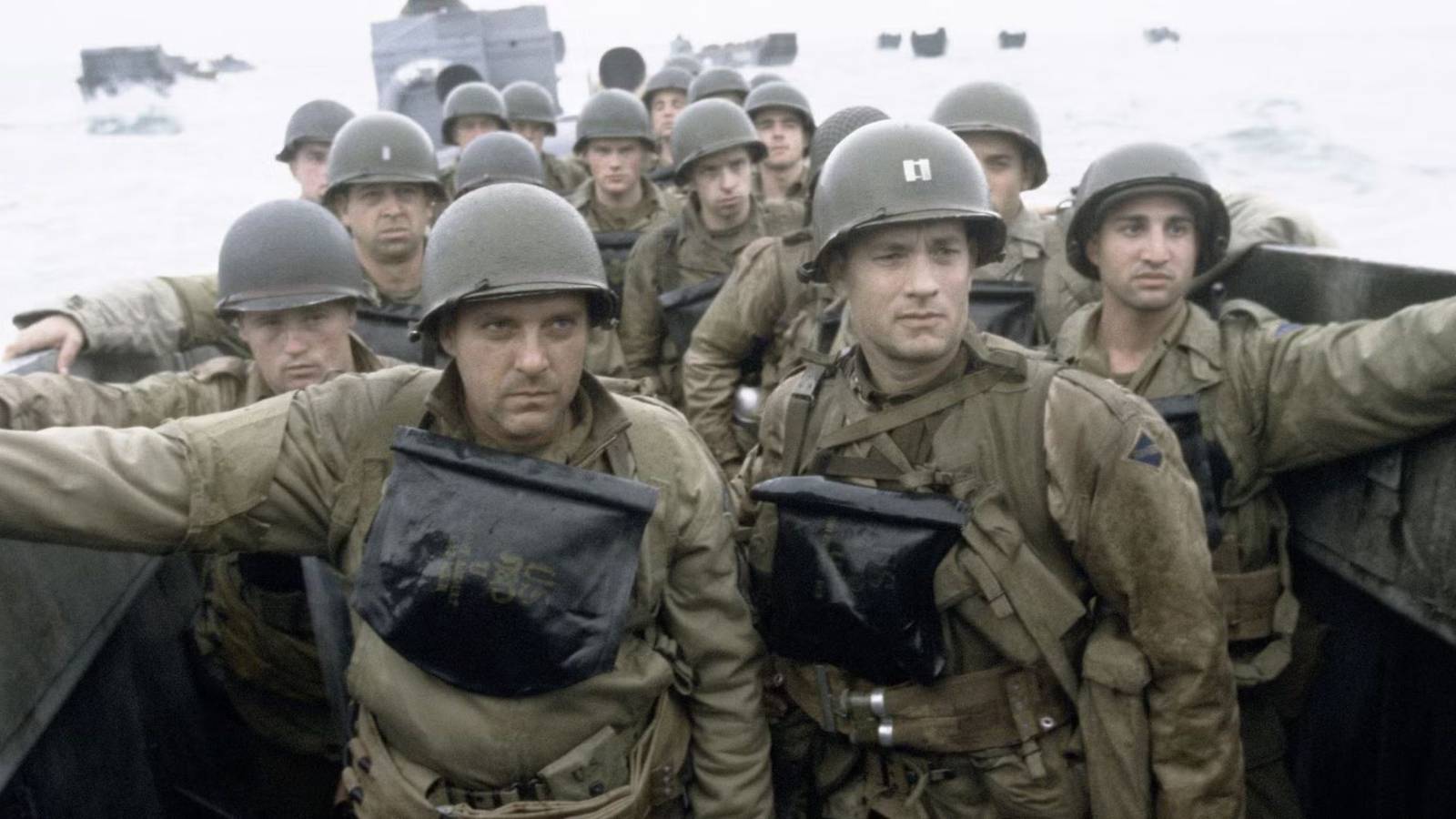
The D-Day landing in Saving Private Ryan is one of cinema’s most frightening depictions of combat, but Steven Spielberg reserves his sharpest emotional blow for the film’s final minutes. Captain Miller (Tom Hanks) and his men have endured enormous losses to bring one soldier home. The mission succeeds, and Miller dies.
The words Miller leaves Private Ryan (Matt Damon) become a burden that follows Ryan through the rest of his life. When the older man visits the military cemetery and asks whether he’s lived well enough, Spielberg transforms a story about battlefield sacrifice into a question nobody else can answer for him.
That ending is why this belongs above more unrelentingly violent films. The Omaha Beach sequence makes the audience fear death. The cemetery makes them contemplate an entire lifetime lived under its shadow. Crucially, the movie still believes saving one person can matter; that sliver of grace distinguishes it from the top three.
3
Schindler’s List (1993)

Steven Spielberg’s Schindler’s List confronts the Holocaust on a vast scale, yet some of its most affecting moments are almost unbearably specific. The little girl in a red coat, visible amid the black-and-white devastation of the Kraków ghetto, becomes a haunting image of a life reduced to a fleeting glimpse.
Liam Neeson’s Oskar Schindler begins as an opportunist who learns to use his connections to protect Jewish workers from extermination. By the end, saving more than a thousand people has not relieved his guilt. He can only think about the lives he might have saved if he had surrendered one more possession.
It’s that scene, rather than the scale of the horror alone, that makes the film emotionally overwhelming. The survivors understand what Schindler accomplished; he cannot stop measuring what remains lost. The ranking places it near the top for making personal grief inseparable from an almost incomprehensible historical atrocity.
2
Come And See (1985)

Elem Klimov’s Come and See follows Florya, a Belarusian boy who joins partisans fighting Nazi occupation during World War II. He begins with the excitement of someone who believes war might make him older and braver. The film records what happens to that face as every comforting assumption disappears.
The destruction of a village is almost impossible to endure. Klimov avoids the reassuring distance of conventional battle coverage, leaving viewers trapped beside people who cannot escape. Aleksei Kravchenko’s performance makes the boy’s transformation feel physical; by the end, he looks as if decades have passed.
This is arguably the most hopeless film on the list, and a strong contender for No. 1. But its power is so relentless that horror sometimes overwhelms sorrow. The top selection is quieter, allowing viewers to form an intimate attachment before dismantling the smallest hopes of two children.
1
Grave Of The Fireflies (1988)

An animated movie about two siblings trying to survive the final months of World War II might sound gentler than the live-action films above. Isao Takahata’s Grave of the Fireflies is anything but. After an American firebombing leaves Seita and his little sister Setsuko without their mother, the children are forced to navigate hunger and indifference largely on their own.
Their relationship makes the film devastating. Seita tries to maintain some semblance of childhood for Setsuko, who still finds pleasure in fireflies and sweets. Those small comforts gradually disappear, and the familiar candy tin becomes a reminder of how little she ever asked of the world.
Takahata’s restraint is merciless. There is no grand heroic sacrifice or last-minute rescue. Ordinary neglect becomes as destructive as the bombs. Grave of the Fireflies earns No. 1 because it makes the human cost of war brutally specific. Long after the credits, it’s the candy tin that stays with you.
