

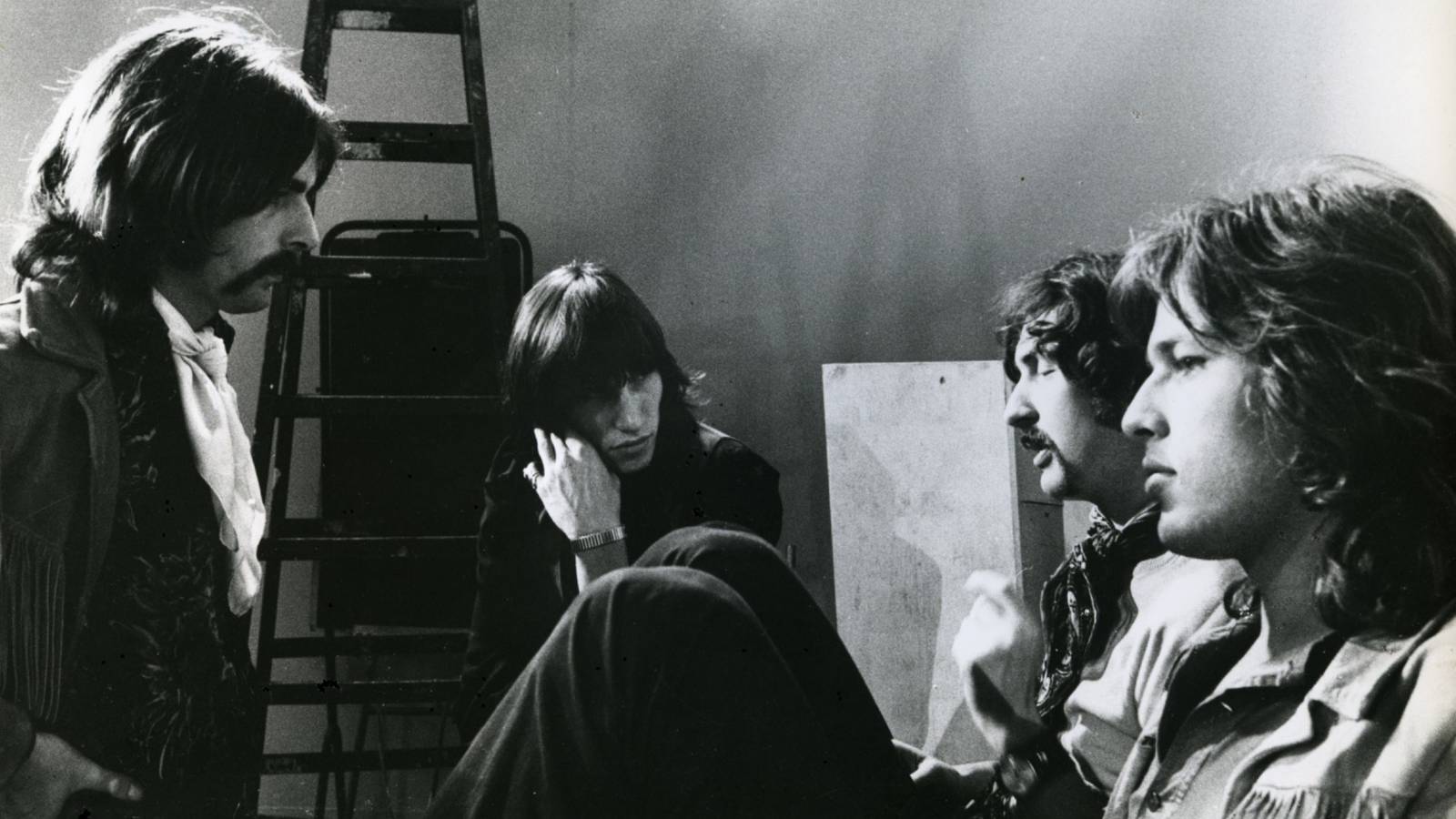
Pink Floyd is a group with a story unlike any other. They lost their leader after just two albums, when Syd Barrett had to take a step back from the music due to his growing mental illness. After their peak in the 1970s, a relatively quiet feud between the band’s two lead vocalists, Roger Waters and David Gilmour, caused some riffs that they still have yet to fully reconcile. Suffice it to say, the British psychedelic rockers have been through the ringer, more than a few times.
Even amid all the turmoil, perhaps because of it, Pink Floyd managed to create some of the greatest genre-defining psychedelic rock music ever made. Every single one of their 15 studio albums charted in the top ten on the UK’s Official Albums Chart, with five of them reaching the number one spot. By the time they released The Dark Side of the Moon, that, and every subsequent album of theirs, reached the top ten on the Billboard 200 chart.
There’s no doubt that a majority of the band’s legacy came from their three most successful works: The Dark Side of the Moon, Wish You Were Here, and The Wall. That said, between the latter two came an album that I, personally, consider one of the most underrated albums of all time, and that I firmly believe deserves as much praise as the rest of them: Animals.
Animals, One Of The Greatest Concept Rock Albums Of All Time, Was Released 49 Years Ago Today
Firstly, I want to point out that three of this album’s five tracks are about pigs. The first and the last tracks are both titled “Pigs on the Wing,” differentiated by the numbers one and two, indicating that they are meant to be linked. The second version of “Pigs on the Wing” picks up essentially where the first one left off, with a subtly sweet acoustic guitar accompanying Roger Waters, his vocals much different, much softer than how we know them to sound.
The lyrics to “Pigs on the Wing 1” are as follows:
If you didn’t care what happened to me
And I didn’t care for you
We would zigzag our way through the boredom and pain
Occasionally glancing up through the rain
Wondering which of the buggers to blame
And watching for pigs on the wing
That is, in fact, the entirety of the song. From there, leaving us dangling off the cliff of “Pigs on the Wing 1,” the guitar ushers us into “Dogs,” the only track on which David Gilmour sings lead vocals. Where Gilmour typically provides a melodic reprieve from Waters’ eery, wiry vocals, however, “Dogs” shows off a much grittier side of Gilmour as a vocalist. The guitar solos on this track are simplistic yet wailing just the same, building upon the tension of the steady rhythm and Gilmour’s worrying vocals.
After “Dogs” comes the second song about pigs on the album, “Pigs (Three Different Ones),” which starts with an odd, futuristic synthesizer riff, accompanied by a chorus of pigs snorting and, of course, a soft and simple guitar line. As the song progresses, it takes on a more soulful, almost blues-like tone, at times, reminiscent of a jam band.
This particular song about pigs is where the album’s overall concept really starts to take shape—loosely based on George Orwell’s Animal Farm, “Pigs (Three Different Ones)” pokes fun at those working to maintain the ladder of capitalism, while never actually reaching the top. “Dogs,” we then realize, is a critique of those at the top, who eat away at those beneath them, which brings us to “Sheep.”
“Sheep” is a song about the middle class majority. Those within our society who continue to be victimized by the dogs, and the pigs who work relentlessly towards maintaining that class order and hierarchy. “Sheep” takes a step back after the musical chaos upon which “Pigs (Three Different Ones)” closes out, starting with calming animal noises, and a groovy keyboard line to ease us in. The song has a sort of inspirational quality, jumping off of the anger invoked by the previous track and making listeners feel understood above all else.
That soft and understanding feeling does not last, however, as “Sheep” becomes more of a rallying cry to overthrow the dogs, quite literally with the lines, “Through quiet reflection, and great dedication / Master the art of karate / Lo, we shall rise up.” Once again, however, the feeling doesn’t last, as the last stanza of “Sheep” explains that even though the dogs have been overthrown, the pigs are still out in the streets, maintaining any semblance of structure they can find.
Have you heard the news?
The dogs are dead
You better stay home
And do as you’re told
Get out of the road if you want to grow old
After “Sheep” closes out and puts an end to the rollercoaster that is the meat of this album in its three central tracks, we arrive back at “Pigs on the Wing 2,” where Waters once again begins singing the refrain from deep within his heart:
You know that I care
What happens to you
And I know that you care
For me too
So, I don’t feel alone on the weight of the stone
Now that I’ve found somewhere safe to bury my bone
And any fool knows a dog needs a home
A shelter from pigs on the wing
As the album winds to a close, we are brought back once again, to the pigs. Only this time, we are made to realize that many of us are best categorized as pigs on the wing, caring about those close to us and sticking together, but blindly maintaining the hierarchy that serves to benefit the dogs—so long as we do not become sheep, many of us are content in acceptance, simply watching as pigs on the wing.
Of course, Animals would not have come to be without Orwell’s groundbreaking political commentary in Animal Farm, but very few artists have accomplished such poetic and poignant commentary in their music as well.
Prior to Animals, Pink Floyd never shied away from difficult subject matter, but oftentimes it felt like the mirror was pointed inward, like their music examined their own lives and inner psyches, which is part of what made it so great. What makes this album different is that the mirror is turned outwards, as they sing about society and the world around them.
The best part? They mastered both viewpoints, and created in Animals an equally fantastic work of art. 49 years later, and this album is still just as relevant, and just as groundbreaking.
