

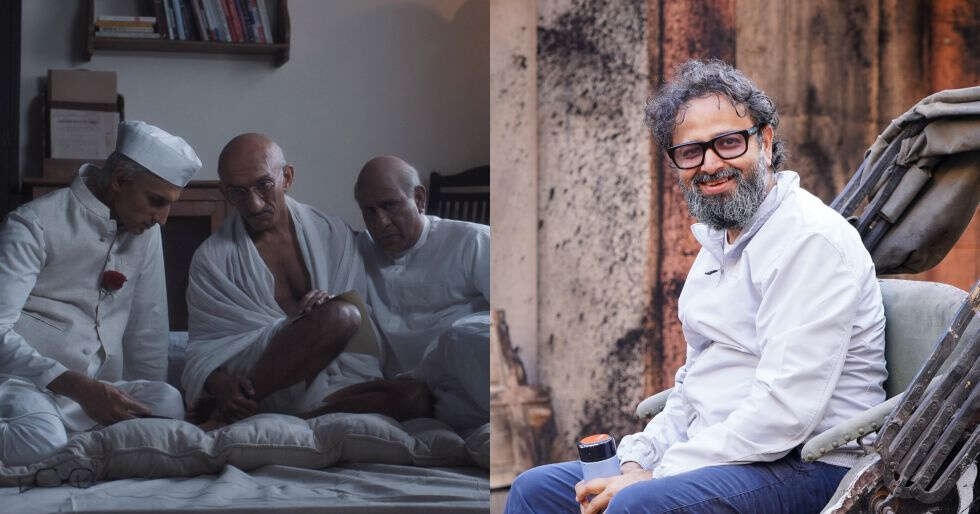
While making the show, what was going through your mind?
Gandhi’s ideas of unity, peace, and non-violence echo across the season. Do you feel that history has truly moved forward, or are we still grappling with the same questions?
You have to stay anchored to the book. It has to be your source material. There’s a reason we chose to follow Freedom at Midnight by Dominique LaPierre and Larry Collins. Some will call it a Western gaze because the writers are from the West but what’s undeniable are the events that actually took place and their impact. That becomes your starting point. From there, wherever you feel the need for deeper understanding, you look for additional perspective to view those moments from different sides. You’re dealing with the Congress and the Muslim League, Gandhi, Nehru and Patel on one side, Jinnah on the other, with Mountbatten in between, often fumbling through it all. But the book remains the core.
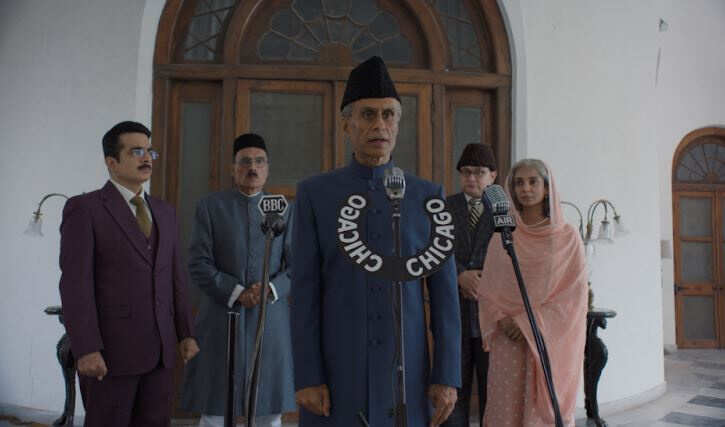
Were there moments where you took creative liberties?
It wasn’t so much about creative liberties as it was about making clear choices. I see the Freedom at Midnight writing room as a case study in how a writing room should function. We had a logline: the sacrifice of many and the ambition of one. A lot of people might say, why is Jinnah so unidimensional? And that’s fair. But I was making a show where, if I had to sacrifice Jinnah at the altar of Nehru, Patel, Gandhi, I’m good with that. But it’s the choices, it’s not so much about the creative liberties. Creative liberty comes into play the moment when you are making something that needs a certain level of thrill or dramatisation. The real challenge was about deciding what choices we were making.
Was there a moment of hesitation about being misunderstood when you chose to tell a story so deeply tied to our national memory?
I’m misunderstood all the time and I am used to it. But yes, there is that fear. We were walking a line where people could easily take sides. That’s why it was important for me to place the viewer firmly in that moment, in that time, right at the centre of the events. I wanted to ensure that not even for a second do you doubt that the decisions these leaders were making were driven by the belief that they were either trying to prevent things from getting worse or, in some cases, inevitably making them worse. I’m not judging Nehru, Patel, Jinnah, Mountbatten, or Gandhi. What I am trying to do is place you in that moment. You might be coming from a different point of view. I don’t have the power to tell you that I am right. I have the power to put you in that place and tell you about the events that unfolded and hope that you will be able to understand what they were going through at that time.
What does it take today to convince platforms to back a historically dense storytelling such as Freedom at Midnight?
A show like Freedom at Midnight has to be mounted in a very specific way. It has to come from belief at the top. Whether it’s Samir Nair reading Ramachandra Guha’s book and feeling that Hansal Mehta is the right person to make it, or Danish and Saugata reaching out to me for this show, it has to originate from the brand.
What kind of projects are really hard to get greenlit today?
It’s very difficult to get anything greenlit. There are several factors that have to come together at the right time, be it budget, cast, story, showrunners, creator and even the audience. Whether it is too niche or too mainstream for the audience. What OTT platforms are greenlighting in 2026 will be coming out in 2028. So you have to be like a soothsayer, and have the right data to say that two years from now, this is going to work.
What next after Freedom at Midnight?
Freedom At Midnight stars Sidhant Gupta, Chirag Vohra, Rajendra Chawla, Arif Zakaria, Ira Dubey, Malishka Mendonsa, Rajesh Kumar, KC Shankar, Luke McGibney, Cordelia Bugeja, Alistair Finlay, Andrew Cullum, and Richard Teverson among others.
Also Read: Freedom At Midnight Season 2 Review: Through A Scanner Darkly
