

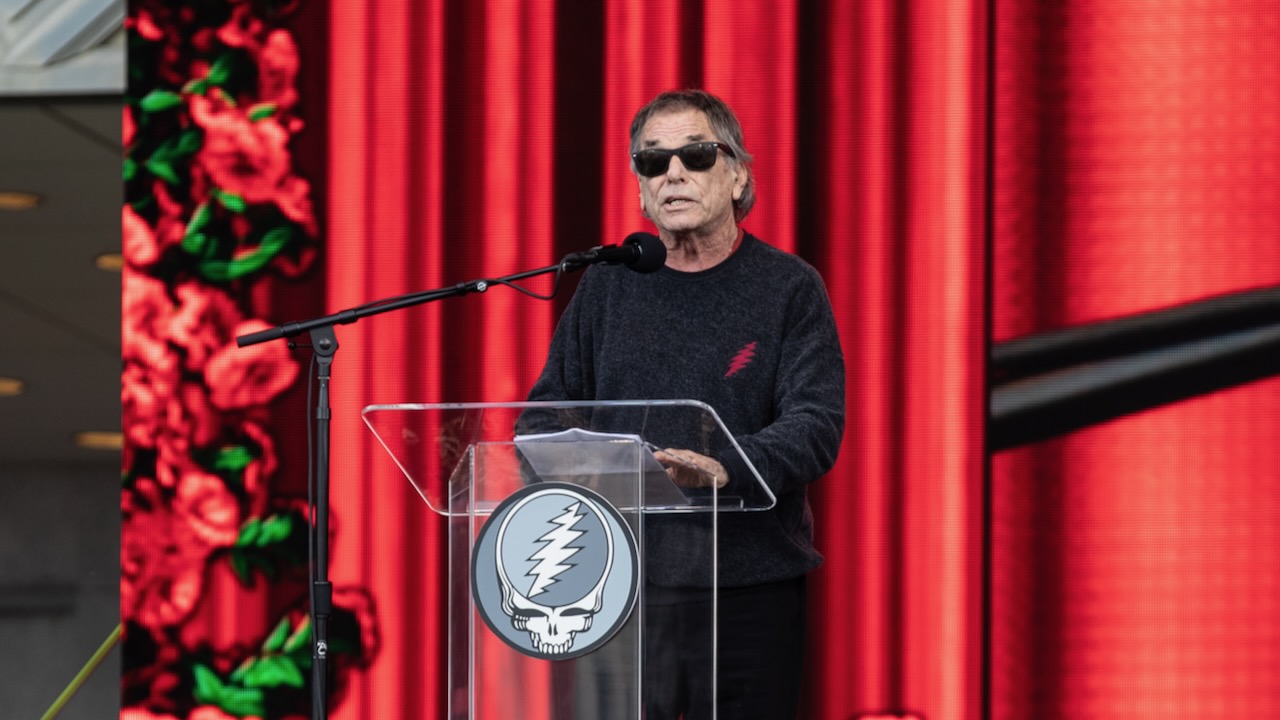
Along with John Mayer, Mickey Hart eulogized Bob Weir at a public memorial held in San Francisco on Saturday, remembering his late Grateful Dead bandmate as a true original.
Hart recalled first hearing Weir at a Haight Street theater in 1967 and being consumed by the sound, describing the young guitarist’s unusual chords and singular feel as “home.” He painted Weir as both a visionary musician and the band’s comic relief, sharing a humorous anecdote about the time the two snuck into a zoo to record animal noises.
“There was nothing like Bob Weir,” Hart noted. “He was singular. He was not a copy of anything that came before; he was a true original. I could sit here and tell you so many stories about our lives together, but at the heart of it all is that this was never just a band. It was a family. We grew up together. We lived together and raised our kids alongside each other.”
Related Video
For Hart, Weir’s legacy lives in the Dead Head community that continues to carry the songs forward: “The music was a necessity and the connection to a community was its power base… The songs of our lives are yours now, and it’s up to all of us to keep the refrain building. Love is real, not fade away.”
Other speakers at Weir’s memorial included John Mayer (who also performed “Ripple”), Joan Baez, Speaker Emerita Nancy Pelosi, and San Francisco Mayor Daniel Lurie. There was also a video tribute featuring Willie Nelson, Sammy Hagar, Wynonna Judd, Warren Haynes, Phish’s Trey Anastasio, and Bruce Hornsby.
Read Hart’s full eulogy for Weir below:
“The Grateful Dead was a ritual band. I felt it the first time I heard Bob play as I walked into that street theater on Haight Street, September 29th, 1967. That night, the theater was dark, dark enough for the band to disappear into only sound. It was consuming. It permeated every pore in my body. I felt the vibrations creep up my spine and, suddenly, I was whole. I was home. Bob was just 19 that first night at the Straight Theater, his long fingers making chords few others could physically reach or thought were even possible.
“His choices, like the way he navigated through life, were his own. What defines those early years, though, was the laughter. Bob was funny, and he loved funny. Bob was the band clown, a very endearing comic relief from the tedium of the road. You could always depend on Bob to have a squirt gun or a noisemaker or something going on in airports to attract attention and challenge the rules. Now, we all love breaking the rules, but Bob, he was really good at doing it in public.
“No doubt, sometimes we could get a little carried away. One day, we woke up and Bob announced that we were going to the zoo to record the animals. It was a full moon, which was very important to Bob; he assured me that’s when the animals are at their loudest. I thought it was a great idea, but the problem with the plan was that we didn’t have gear and neither of us were recordists. We thought Owsley might loan us his Nagra recorder, so we showed up at Owsley’s and he taught us how to record. Then, at midnight, we arrived at the zoo. But as we climbed the gate, we got entangled in the barbed wire. We hung there from the wires on the inside of the fence and laughed so hard that the guards came, shining their lights and grabbing us down. Not knowing what to do with us, they let us go. As we left, we paused for a moment and looked back in the rearview mirror, stopping to consider what the recording might have been. But we found the zoo was totally silent, not a sound. That was perfect, Bob.
“Yeah, there was nothing like Bob Weir. He was singular. He was not a copy of anything that came before; he was a true original. I could sit here and tell you so many stories about our lives together, but at the heart of it all is that this was never just a band. It was a family. We grew up together. We lived together and raised our kids alongside each other. Together we rode horses across my ranch in Nevada all the way to the Great Pyramids. We traveled down a thousand roads, roomed with each other in every blue-light cheap hotel, and stood beside each other from New Orleans parish prison through the doors of the Oval Office.
“As he grew older, Bobby fully embodied the role of troubadour, but also became an incredible family man. The bus became home to Bob, Natasha, and the girls. It always made me happy when I saw that bus coming down the road, mainly because Bob was pretty much late all the time. He was charmingly late, let’s put it that way. Bob liked to talk about where the music would be in 300 years. After watching it all build for 60 years, he could envision the depth of our impact hundreds of years down the line. He had that kind of vision. He saw the music in all its different forms and genres. He could hear the songs played symphonically; he could hear them plucked by bluegrass players, woven through a second line, or echoed through the Grand Ole Opry. He knew the songs would have a life of their own, not just because of who wrote them and where they came from, but because of where he felt future generations might take them. Not because of us, but because of all of you.
“For the Grateful Dead, the music was a necessity and the connection to a community was its power base. Where that’s most tangible is in the encore, when the stage goes quiet and the crowd takes over the song. Singing in the absence of a voice from a microphone, it’s there with all of us bathing in the collective refrain. You can really feel the power of the music, of the community it came from, and ultimately the community that it inspired. The songs of our lives are yours now, and it’s up to all of us to keep the refrain building. Love is real, not fade away.”
