

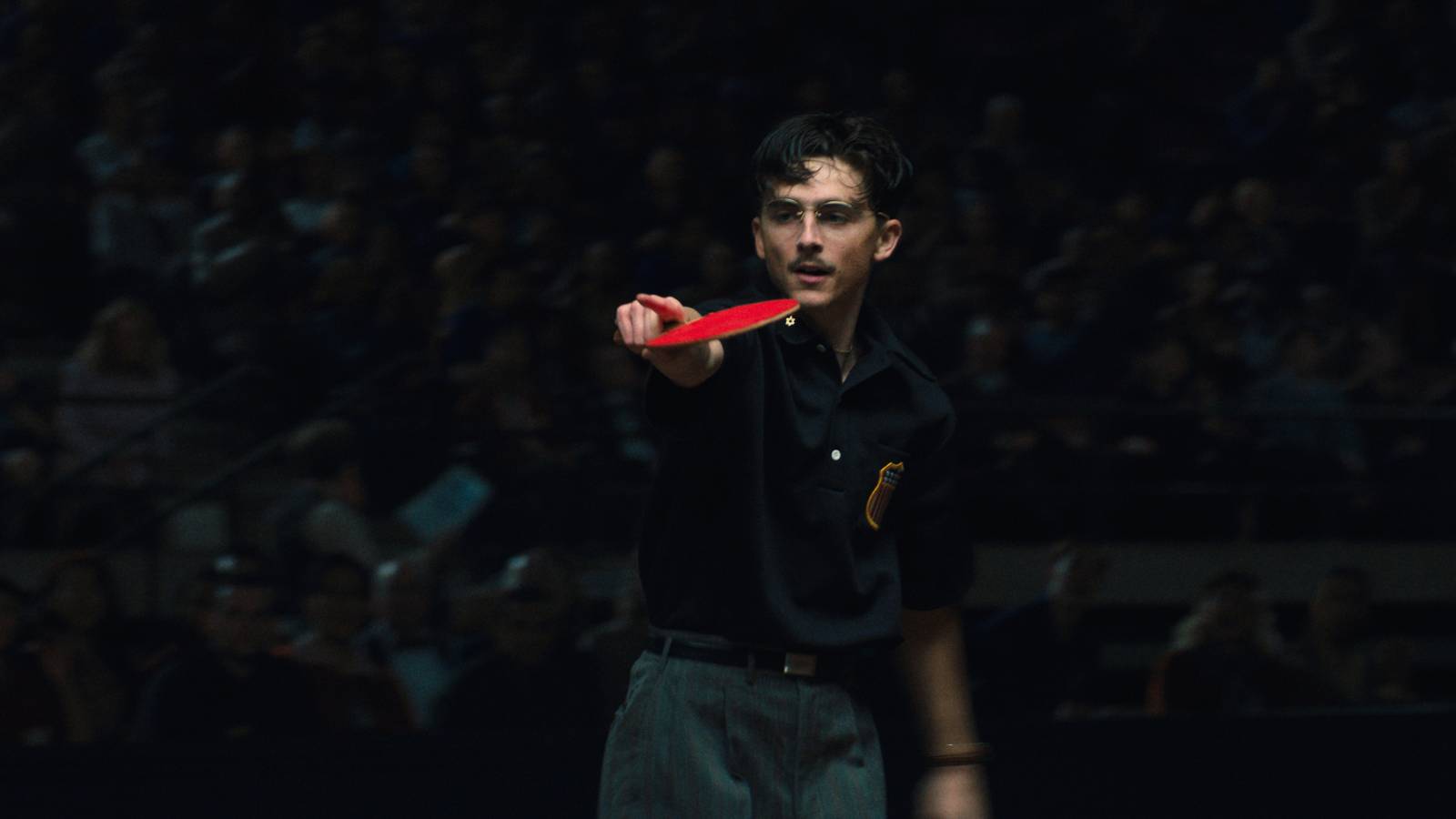
As highly acclaimed as it was unrelenting, Uncut Gems felt like the apotheosis — or at least the highest possible concentration — of creativity wielded by sibling directors Benny and Josh Safdie. Their respective 2025 returns to solo filmmaking, however, suggest that working together may have diluted their individual talents: Josh’s Marty Supreme is the most intense film released yet by someone with the last name Safdie.
Despite that high bar, it’s also possibly the best. In a career that seems to accumulate only great performances, Timothée Chalamet delivers one of his greatest yet by leveraging his scrappy, boyish charms to make audiences love a character who is frequently anything but lovable. A script by Safdie and Ronald Bronstein transforms the real-life story of tennis table player Marty Reisman into a 1980s sports movie by way of meticulously recreated 1950s Brooklyn by way of the Greek fable of Icarus, while the director ratchets its wonderfully anachronistic journey to a level of tension that eclipses his work as part of a filmmaking duo.
Safdie and Chalamet Put Backspin On 1980s Sports Movie Clichés
Chalamet plays Marty Mauser, a fast-talking, egotistical table tennis star with almost as much talent as he has charisma and tenacity. Narrowly escaping a prescribed fate as the top salesman at a Brooklyn shoe store — and only by robbing his employer for the wages he earned — Marty jets off to London against the discouragement of friends and family for an international ping-pong competition. Underwhelmed by the meager accommodations offered to him by the event organizers, he procures a room at a nearby four-star hotel, in the process catching the eye of Kay Stone (Gwyneth Paltrow), a movie star bored enough by middle age and her dormant career to embark on a brief but passionate affair.
Despite his bravado, Marty loses in the final round of the competition to Koto Endo (Koto Kawaguchi), a Japanese player with a much more modest demeanor — and more importantly, an unconventional stroke that seems virtually unbeatable. Returning home in disgrace, Marty starts hustling with his pal Wally (Tyler Okonma) to raise enough money to mount a comeback, even as he discovers that his childhood friend Rachel (Odessa A’zion) is pregnant, and insisting that he’s the father.
As the authorities bear down on him for his “burglary” and he alienates one person in his life after another with an escalating series of transgressions, he turns to an unlikely source of support for funds: Milton Rockwell (Kevin O’Leary), Kay’s business-magnate husband. But even if he’s able to convince Rockwell to bankroll his revenge match with Endo, it may come at a greater cost than he’s willing to pay — to his career as a table tennis player, much less his dignity.
Suffice it to say that the description above barely scratches the surface of what happens in the film — and, in fact, it only makes me want to watch it again right now. Like Uncut Gems (which Bronstein also co-wrote), there’s a consistent, chaotic energy that Safdie maintains that risks audience exhaustion, but while it’s happening, it feels absolutely exhilarating. But, the swings he takes here are absolutely huge: in the opening credits, there’s a shot that dissolves from a mother-to-be’s freshly fertilized egg into a ping pong ball bearing the name of the film as Marty delivers a punishing serve to an opponent in a high-stakes match.
The film in many ways recreates the rhythms of an ‘80s sports movie, focusing on a promising athlete who encounters his fiercest opponent and must fight for the opportunity to see who between them is truly the best. It’s easy to see the influence of Martin Scorsese’s After Hours, and especially The Color of Money, in the way the filmmaker spirals around the table, capturing the sport’s simultaneous speed, precision and unpredictability. In fact, Safdie enlists Good Time and Uncut Gems composer Daniel Lopatin to create a score which, paired with synth-pop classics like “Everybody Wants to Rule the World” and “Forever Young,” far more vividly evokes the synclavier era of Karate Kid and Rad than it does the film’s 1950s time period.
Yet, Safdie sets the film deep in a blue-collar Jewish 1950s New York, and provides such detail you can’t help but be reminded of the richly drawn worlds of The first two Godfather films, or the misadventures of Max and Noodles in Leone’s 1984 opus Once Upon a Time in America — the close quarters, the community, the simmering tensions and the pragmatism of parents and mentors that risks squashing a young man’s irrepressible dream. His mother, his uncle, and the adoring girl next door dismiss his proven skill as “mishegoss;” it only seems to motivate him further.
Combined with absolute shamelessness, that perseverance produces a trail of hurt, betrayed or offended souls in his wake, and it’s in the character’s duality that Chalamet delivers work as finely tuned as his character’s table tennis game. There is something undeniably attractive about Marty’s absolute and unwavering belief in himself and determination to achieve his goals, but evidence of its pejorative effect on everyone (including him) appears early, and causes more and more havoc the more desperate he becomes. As intoxicating as it clearly feels to be welcomed into Marty’s confidence, or to receive his attention, Chalamet embraces his immaturity, impulsiveness and selfishness with equal vigor. You understand why those around him often seem as dazzled as they are exasperated by him, frequently at the same time.
Paltrow’s semi-retired status gives an authentic sheen to Kay Stone’s declining movie star wattage, but her effortlessness with the role’s complexity — too smart to be hustled, but just insecure to let herself be susceptible — underscores she’s lost none of her own talents. Navigating an unhappy marriage to a brute (a simmering Emory Cohen) while secretly carrying Marty’s child, A’zion makes Rachel a worthy counterpart, even co-conspirator, to the would-be ping pong legend’s calculating self-fulfillment. The sun of his magnetic personality burns brightly, but she orbits around him so deftly that she never gets obscured.
The film’s older cast members, from Fran Drescher and Sandra Bernhard to filmmaker Abel Ferrara and Penn Jillette, all manage to deliver powerful turns, the latter two particularly chilling. But Shark Tank investor O’Leary holds his own against an in-the-zone Chalamet in a way I wouldn’t have expected; a first-time actor, he certainly leans on his entrepreneur bona fides to make the character believable, but his ruthlessness, and yet lack of compassion, forms the perfect opposite to Marty. Every scene between the two of them feels like you’ve been put inside a cage with two tigers — one older, more seasoned and patient, but the younger no less ferocious.
Much like Marty’s appeal, mileage may vary for the fever pitch that Safdie maintains here; Josh never lets off the gas in comparison to the more measured pacing of storytelling by someone like, say, Scorsese or Paul Thomas Anderson. But that full-throttle approach is so dense and encompasses so much, including both grand sports-movie payoffs and an extraordinary arc for its title character, that if anything, it over delivers. Though its far-reaching ambitions and many stylistic juxtapositions might make it seem like the work of two (or more!) filmmakers, Marty Supreme isn’t just a masterpiece, but feels vividly like a cohesive — and singular — vision.

Marty Supreme

10/10
- Release Date
-
December 25, 2025
- Director
-
Josh Safdie
- Writers
-
Ronald Bronstein, Josh Safdie
- Producers
-
Anthony Katagas, Ronald Bronstein, Timothée Chalamet, Eli Bush, Joe Guest, Timo Argillander
