

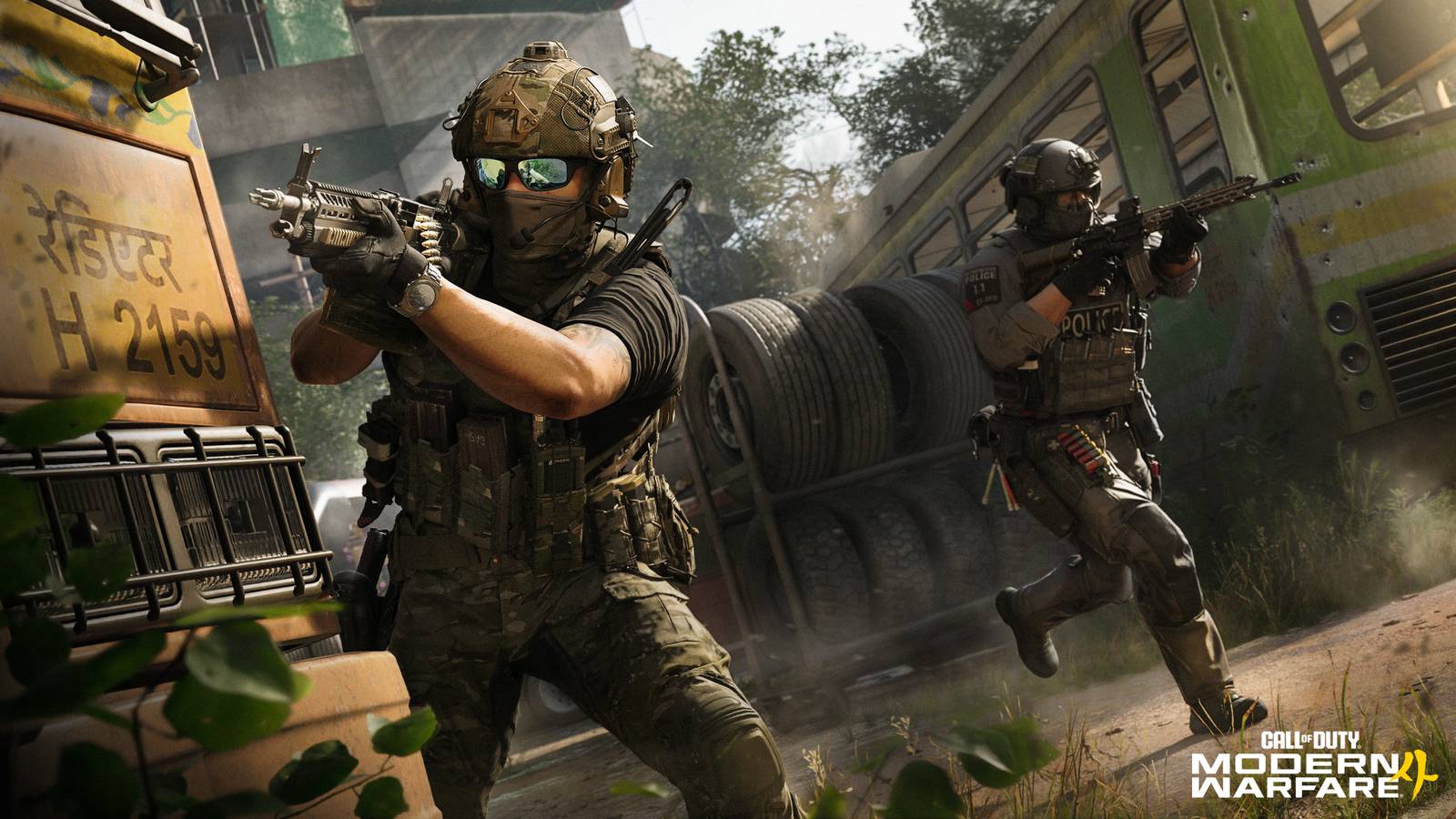
Last week, I visited Infinity Ward for an early look at Call of Duty: Modern Warfare 4. After walking through the studio lobby where a towering Ghost statue resides, we were brought into a transformed kitchen and common area where the team had recreated a South Korean street market complete with vendors, props, signage, and themed food inspired by the game’s new setting. I discussed this “refresh” and the campaign already, so here we’ll dive into the multiplayer and tech.
Over the course of the visit, I sat through presentations breaking down Infinity Ward’s multiplayer overhaul, including rebuilt movement systems, the new Ballistic Authority framework, major rendering and visibility upgrades, and several franchise-first gameplay changes before going hands-on with multiple maps, modes, weapons, and the new Kill Block dynamic map system.
Modern Warfare 4 Revealed: Inside Call of Duty’s Big, Much Needed Refresh
I visited Infinity Ward to play Modern Warfare 4 and see how it’s refreshing Call of Duty with new locations, tech, and bigger campaign.
I’ll dig into that below alongside the redesigned traversal mechanics like momentum-preserving mantles, dynamic ledge leaning, supine sliding, ladder slide transitions, and rebuilt vaulting systems, and the game-changing changes made to the gunplay itself, including the complete removal of bloom. Yes, you read that right. Other notable and exciting changes include the game rendering both the weapon and game world from the same field-of-view perspective for the first time in franchise history, a major overhaul designed to make what you see and he combat feel more realistic and readable during firefights.
Beyond these core combat systems, the presentation and my interviews also covered new progression and customization features like Apex Attachments, gameplay-altering endgame weapon upgrades, and Gunny, a new smart Gunsmith assistant that automatically generates weapon builds around different combat roles and playstyles. Modern Warfare 4 also fleshes out loadouts by allowing players to assign unique operators to individual classes for the first time in franchise history, alongside reworked Prestige systems that split progression into separate classic and non-reset tracks. Let’s get into it.
Modern Warfare 4’s Movement Has Been Rebuilt From The Ground Up

Movement is one of the biggest focuses in Modern Warfare 4, and Infinity Ward says nearly every traversal mechanic has been revisited or rebuilt entirely. Design Director Jacky Reynolds.:
We set out to make the most unrestricted and fluid movement system that we’ve ever shipped as a studio.
That overhaul touches almost every part of movement. Sliding, mantling, climbing, vaulting, ladder transitions, and traversal animations have all been redesigned to preserve momentum and reduce friction between player intention and on-screen action.
During the hands-on session, this all seemed to work as intended. Everything just flows and your player character does what you want, naturally and with ease. While there’s a flow to the movement, and the way the weapon moves as you do, Modern Warfare feels appropriately slowed down compared to what we got with Black Ops 7. There are no wall jumps or grappling hooks and the word “omnimovement” wasn’t uttered once.
Mantling no longer abruptly kills momentum, players can dynamically lean while hanging from ledges, slide directly into ladder descents, cancel out of animations, and even chain movement options together in ways that create a much faster and more fluid combat rhythm. It’s more about intent and immersion versus speed in practice. Multiplayer Director Joe Cecot:
“How do we build a fluid, fast, responsive first-person shooter that’s still grounded in realism? How do we make a game where the tactical player and the fast-run and gun player each feel like they found the perfect game for them?”
Infinity Ward also introduced and outlined several entirely new traversal systems, including a “supine slide” that allows players to slide on their backs directly into prone, dynamic ledge shimmying, and momentum-preserving mantle slides that let aggressive players continue pushing through firefights without interruption. Reynolds said the team’s goal was to eliminate moments where the game prevents players from doing what they instinctively want to do during combat movement.
The studio even built a mobility course that Modern Warfare 4 will launch with, specifically to stress test the system, with Reynolds describing how developers became obsessed with improving their times and pushing movement systems to their limits.
Modern Warfare 4 Is The First AAA Shooter To Completely Remove Bloom

The other major focus is gunplay, and Infinity Ward is making a very bold claim here: Modern Warfare 4 will become the first AAA shooter to completely remove bloom-based hipfire systems. It’s really happening.
For years, shooters have relied on bloom, a system where bullets randomly deviate inside an invisible cone of fire regardless of where the weapon is visually pointed. It’s artificial and it’s outside of player control, so people always complain about it in shooters. Infinity Ward straight up says bloom is “antique” and annoying so they’ve gotten rid of it. A video demonstrating the changes explains:
The vast majority of discussions about Bloom are extremely critical of this unfair, unrealistic method. Yet all shooters, including Call of Duty, rely on this technique to control accuracy, because there is no alternative until now. Modern Warfare 4 will be the first AAA shooter to ditch this method. In our game, the bullet goes exactly where the weapon is pointing. We developed a realistic physical simulation of human motion that more precisely illustrates where the bullet will go, so players get more consistency with every shot. We simulate convergence to keep the weapon pointing where you are aiming, so the weapon is oriented towards the point of impact when shooting targets far away. This is the most authentic convergence in any first-person shooter.
The replacement of bloom is part of a much larger combat framework Infinity Ward calls the Ballistic Authority system, which combines weapon framing, recoil, visibility, audio, physical handling, convergence, and animation systems into what the studio describes as its most authentic gunplay model yet.
In practice, firefights felt noticeably cleaner and more readable during my playtime, especially when using ironsights. Weapon recoil appears more physically connected to the weapon model itself, sight pictures remain substantially clearer during sustained fire, and target tracking feels more consistent, especially while moving aggressively around corners or firing from the hip.
Infinity Ward Is Making Massive Technical Changes To Gunplay & Visuals

Another interesting technical change involves how Modern Warfare 4 renders weapons and environments and what comes next show was the most important and impressive stuff we saw while visiting Infinity Ward, the kind of stuff that seems to position Modern Warfare 4 as a next-gen title of the series, something needed and welcome after the last few years.
Historically, Call of Duty weapon models and environments have been rendered using different field-of-view values, something Infinity Ward says creates unrealistic weapon distortion and disconnects the gun from the game world itself. For Modern Warfare 4, both are finally rendered from the same perspective for the first time in franchise history.
Over the years, the field of view of the games world has increased, but the field of view of the weapon has remained the same. This unrealistic technique makes weapons appear compressed compared to real-life weapons viewed from a first-person perspective in Modern Warfare 4, we render the scene and weapon at the same field of view, so the player’s perspective is more authentic. To make the experience more cinematic, we apply photorealistic lens distortion and a small amount of depth of field. This fundamental change to the framing allows our weapon art, animation, and handling to feel more natural, more realistic, and more immersive.
The studio is also introducing a new “Enhanced FOV” system that combines lens distortion and wider environmental awareness without shrinking target readability, alongside updated depth-of-field rendering, smarter muzzle smoke masking, more advanced recoil simulation, environmental weapon interactions near walls and cover, and a new shockwave system that can knock players down during nearby explosions instead of simply killing them outright.
Geoff Smith, Studio Multiplayer Creative Director, says the overall goal was to make firefights feel more cinematic and reactive without losing the grounded tone Infinity Ward is known for. Smith described the intended tone as “slick and sophisticated, but still gritty and grounded with current military technology.”
The environmental interaction systems are especially noticeable during matches in some interior locations on the regular maps. Objects scatter apart during firefights, explosions send debris and environmental props flying across rooms, etc.. It’s not something I thought about other than noticing the visuals felt improved across the board.
Apex Attachments & Gunny Added to Gunsmith

Infinity Ward is also adding some elements to how weapon customization through new systems like Apex Attachments and Gunny.
Apex Attachments function as endgame weapon unlocks that fundamentally change how guns behave. Every weapon in the game has at least one. During the presentation, Infinity Ward showcased examples, including explosive shotgun rounds, a sidearm with a side break 12-gauge shotgun mounted directly to the frame, a bolt-action sniper rifle with a side-saddle holding three quick-detached throwing knives, the Cronen Squall AR with a laser-guided rocket munition featuring a built-in rangefinder, an advanced stealth suppressor for the North Korean prototype SMG which together create the quietest gun the series has ever seen, and the Hurricane SMG returns as a conversion package for the M4, including its own suite of attachments. Multiplayer Designer Jack Hoppus said:
We wanted these Apex Attachments to be things that players see in the killcam or pick up off a body and go, “Oh shit, my gun can do that now?”
Meanwhile, Gunny (short for the new gunnery sergeant for Gunsmith) acts as a smart weapon build recommender that automatically generates weapon builds around specific playstyles using the attachments players currently have unlocked. How it works: On the weapon loadout screen you can click Gunny in the bottom right and choose between long range to short range to balanced. Three options. And every time you click it, it’ll generate a new viable build from unlocked attachments. I loved this, and used it one every weapon as a starting point, meaning I’d always find myself removing optics from SMGs, but I did get some cool builds from this. There’s no meta button though so overtime, I’m uncertain there’s a use case here for competitive players.
Infinity Ward is also adding some quality of live upgrades to how loadouts work, allowing players to assign unique operators and killstreak setups to individual classes for the first time in franchise history. Choose a ghillie suit skin for your sniper build and give it the Ghost perk, or build a close-range stealth kit with the Ninja and a low profile skin. This is an easy win for the game, letting players have entirely different kits and costumes ready to go based on the map, mode, and situation. It also provides utility for those of us collecting and unlocking a large roster of skins.
Kill Block May Be Modern Warfare 4’s Wildest Multiplayer Idea

“What if we could make a living map that changes every time you play it?” Design Director Jacky Reynolds said while introducing Kill Block during the multiplayer presentation, an unexpected reveal of Modern Warfare 4’s dynamic multiplayer map built around shifting layouts.
Inspired in part by retractable field systems used in real-world stadiums like the Real Madrid football stadium, Infinity Ward built the Westbridge Training Facility, codenamed Kill Block, modular map sections they refer to as “slabs” that dynamically rearrange layouts between rounds and matches.
“The way we approached it was that essentially, the map would be split up into three components that we would call slabs,” Reynolds explained. “Each configuration of this map would be made up of these slabs.”
The central “hero slab” is where the action happens, the main engagement area, but the slaps will feature iconic locations from previous Modern Warfare maps and the slabs will change throughout a match.
“And what’s so cool about this is that the layout will update live while you’re playing the match, so that no two rounds feel the same,” Reynolds continued. “One round you’ll be playing, and you’ll be in a warehouse, and the next you’ll be proning over open trenches.” I experienced exactly this while we tested the map on my new favorite mode: 10v10 Gunfight.
Infinity Ward says Kill Block is roughly the size of Shoot House and will support more than 500 map combinations at launch, with additional configurations planned post-launch. While my hands-on demo focused on the larger scale Gunfight mode, Infinity Ward confirms that the system is ultimately being designed to support all core multiplayer modes.
What Infinity Ward is Not Saying About Modern Warfare 4
And your first look at DMZ via new screenshots. That’s all we can share right now…
Another thing that stood out during my time at Infinity Ward was what the studio chose to focus on and, just as importantly, what it didn’t. Across hours of presentations, developer discussions, and a hands-on session, the theme was that this year’s game is going back to the core values of the best of Modern Warfare in the campaign, multiplayer, and pushing forward on tech. The multiplayer presentation was almost entirely centered on showcasing the improvements to movement, gunplay, immersion, animation quality, map design, and core multiplayer systems.
On the flipside, There was no discussion around cosmetics, crossover operators, flashy gimmicks, or monetization hooks. I can confirm hte post-launch content will rollout in the expected seasonal cadence though. Warzone, despite remaining one of Activision’s biggest live-service pillars, was not mentioned at all during the presentations.
We’re not talking about it yet. But there are more details to come when they’re ready to.
Instead, Infinity Ward repeatedly circled back to ideas like readability, realism, responsiveness, and refining the core feel of Call of Duty itself. In many ways, the presentation and hands-on experience reminded me of when Modern Warfare (2019) was first shown at a preview event. That game felt like a major leap forward for the franchise technologically and stylistically, backed by meaningful gameplay and presentation improvements that immediately stood out from prior entries.
What also stood out then, and appears to be true again with Modern Warfare 4, is that Infinity Ward actually had time to build this vision properly. Following multiple back-to-back Call of Duty releases from different studios in recent years, Modern Warfare 4 and its accompanying DMZ experience feel much more like the result of a longer-term creative and technical investment rather than another rapid annual iteration. I’m sure you’ll see lots of “we’re so back” memes today.
