

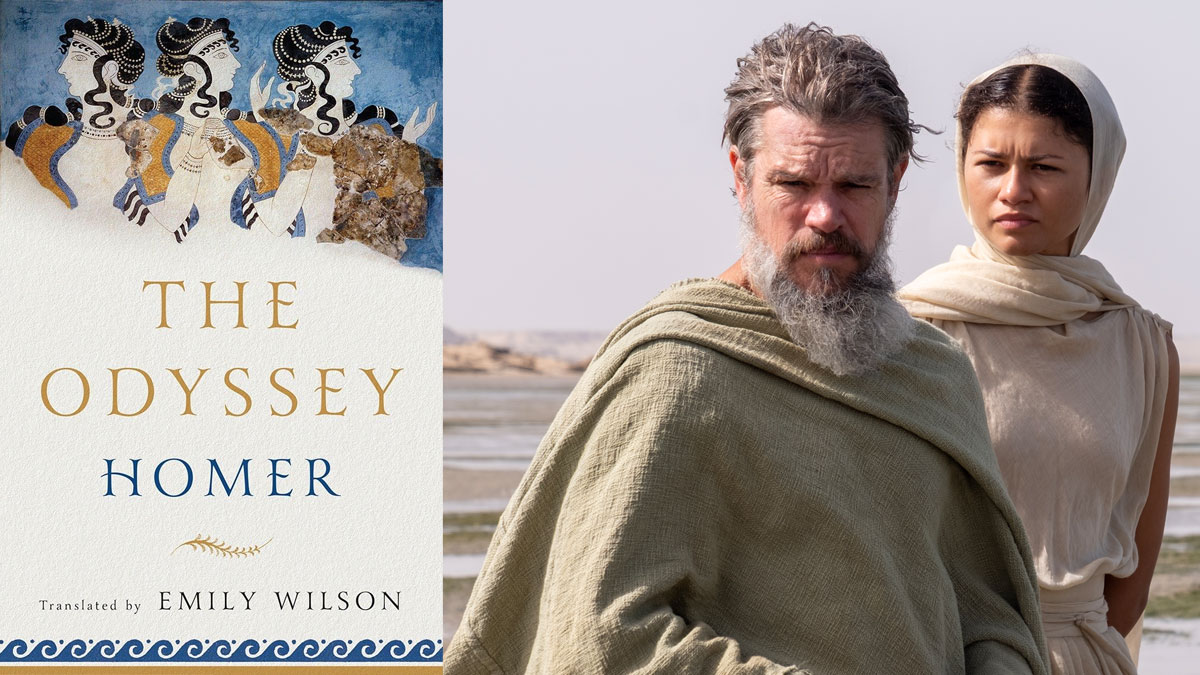
Whenever a big-deal movie adaptation of a big-deal book comes out, there’s always new interest in the original text, whether it be Wuthering Heights or Watchmen. In the case of Christopher Nolan’s The Odyssey, though, we’re talking about the millennia-old epic poem by Homer — 12,109 lines, compiled into 24 “books” (read: chapters). That sounds like a daunting task for a reader, even when translated into English. At least that was the case, until translator Emily Wilson got her hands on it.
Wilson’s translation made waves upon its release in 2017 for the way it took the original language of Homer and made it extremely accessible. “The notion that Homeric epic must be rendered in grand, ornate, rhetorically elevated English has been with us since the time of Alexander Pope. It is past time, I believe, to reject this assumption,” she writes in her introduction, a promise that what you’re about to read is meant to be, well, readable.
As a sample that proves my point, please enjoy this excerpt from Book 5, “From the Goddess to the Storm.” The nymph Calypso (played in Nolan’s film by Charlize Theron) has just agreed to release Odysseus (Matt Damon) from captivity. She’s feeling a little salty about it, though:
The goddess-queen began. “Odysseus,
son of Laertes, blessed by Zeus-your plans
are always changing. Do you really want
to go back to that home you love so much?
Well then, good-bye! But if you understood
how glutted you will be with suffering
before you reach your home, you would stay here
with me and be immortal-though you might
still wish to see that wife you always pine for.
And anyway, I know my body is
better than hers is. I am taller too.
Mortals can never rival the immortals in beauty.”
Related Video
Odysseus, seeing freedom within his grasp, is no dummy:
So Odysseus, with tact,
said “Do not be enraged at me, great goddess.
You are quite right. I know my modest wife
Penelope could never match your beauty.”
Wilson and her work have been back in the spotlight because of the movie’s pending release, as well as the (pretty dumb) culture war that may be erupting around it. In an interview with Vulture, she explains that she finds that “quite baffling. It’s people who don’t care about the poem, yet when it comes to this culture-war internet discourse, they perform anger about it and a protectiveness of it. It has to do with an idea of a totally stable notion of greatness and masculinity: My identity as a man taps into this tradition, and the tradition has always been this way, and my imagined idea about ancient literature confirms that. Anything that challenges that interpretation of what ancient history is threatens their identity in terms of their gender and racial identities.”
What hopefully defeats all of that malarky is the power of a great story — one that the centuries have proven is both constantly up for interpretation by the era in question, as well as infinitely relatable, as all tales about human struggle can be. The medium matters, of course, as books and movies both carry a different sort of influence; you lose the flow of the language with cinema, but gain the opportunity to see Charlize Theron glory in being a true bad bitch.
Wilson’s version of The Odyssey is both a time capsule of long-dead traditions (unless you currently make a habit of slaughtering livestock to welcome people to your home) as well as a reminder that throughout history, people are people, consumed by the same aching woes and petty jealousies and potential for joy. Skip the discourse, read ancient words made modern instead.
The book is available now via Amazon. You might not finish the whole thing before Nolan’s version hits theaters on July 17th, but you’ll still be able to get a taste of how the old and the new come together.
