

The film inevitably reminds you of the 2019 Telangana rape-and-murder case and the subsequent police encounter. The similarities are difficult to ignore: a sexual assault, enormous public outrage and a police response that becomes as contentious as the crime itself. Meghna Gulzar, however, has insisted that Daayra is not an adaptation of that particular case. The film draws from multiple real incidents rather than recreating one identifiable event. That distinction is important, because Daayra is ultimately less interested in one crime than in the larger questions thrown up by such crimes.
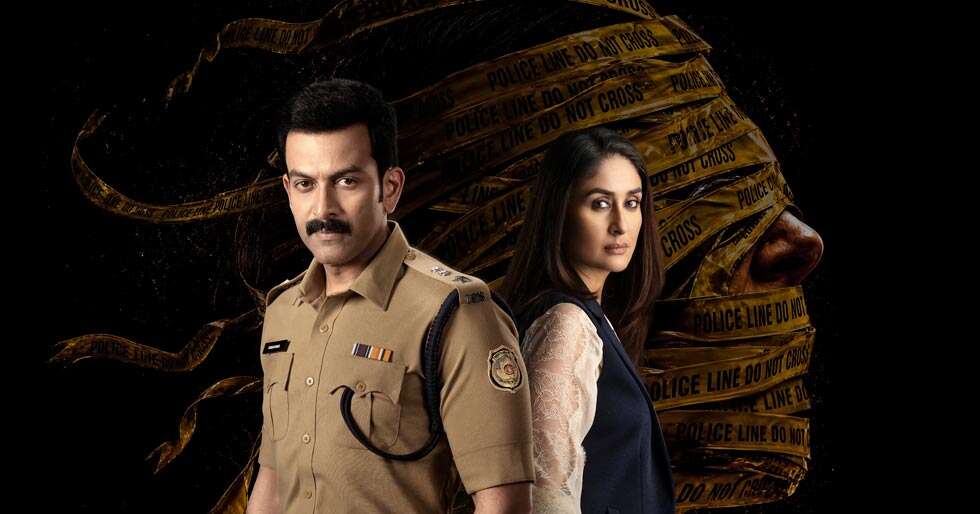
At its centre are DCP Ajooni Kohli (Kareena Kapoor Khan) and DCP Raman Kumar (Prithviraj Sukumaran), senior officers who find themselves on opposing sides of the same system. Ajooni heads an internal affairs team and believes that the law must take its course. Raman has anger issues and has reached a very different conclusion: that extra-judicial killings are sometimes the only way to exact justice. More importantly, Raman doesn’t operate alone. He has a loyal group of policemen who share his methods and are willing to follow him.
This makes Daayra considerably more interesting than a conventional good-cop/bad-cop drama. Raman isn’t presented simply as a villain, nor is Ajooni treated as the infallible voice of reason. They are both products of the same institution, but their understanding of justice is fundamentally different. The film doesn’t quite take sides, although it does seem to lean towards Raman’s point of view. It understands his anger and the frustration that feeds it, even while asking what happens when an individual decides that the law is no longer enough.
Prithviraj gets the stronger and substantially larger part. Daayra is more his film than Kareena’s, and Raman’s journey provides much of its dramatic momentum. Prithviraj plays him with a contained fury that occasionally threatens to spill over. There is no need for grandstanding. His physical presence and increasingly uncompromising behaviour tell you enough about a man who has convinced himself that conventional justice has failed.
Kareena, meanwhile, brings restraint to Ajooni. She plays authority without resorting to the familiar trappings of the heroic cop. There is something deliberately controlled about her performance, which suits a character who believes in procedure. The problem is that the film doesn’t give her enough screen time to develop the counter-argument as fully as it develops Raman’s. Their first collaboration is intriguing precisely because they represent opposing ideas within the same institution, but the balance between them could have been more even.
The supporting cast adds considerably to the film’s sense of reality. Kshitee Jog, as the victim’s mother Parvati Pujari, brings an understandably raw emotionality to the aftermath of the crime. Jitendra Joshi plays Raman’s right hand man, Inspector Karad, while Biswapati Sarkar is effective as Police Commissioner Anand, a senior officer who remains protective of his juniors. Kanwaljit Singh brings quiet authority to the role of Judge Kohli, Ajooni’s father, a man caught up in a court case of his own but who continues to have complete faith in the judiciary. Sandesh Kulkarni, Trupti Khamkar, Anuja Sathe and the rest of the ensemble help populate the film with people who feel like they belong to this world rather than merely exist to service the leads.
That sense of lived-in reality is one of Daayra’s biggest strengths. Production designers Subrata Chakraborty and Amit Ray create police stations, chawls and other locations that look genuinely inhabited. The vehicles have the same quality. Nothing appears suspiciously shiny or freshly dressed for the camera. Karishma Sharma’s costumes follow the same philosophy. The policemen look like policemen, rather than actors playing policemen.
The action is equally grounded. Action director Parvez Shaikh doesn’t turn the cops into invincible action heroes. There is no superhero taking on 20 men and walking away without a scratch. The policemen huff and puff while chasing suspects, get hurt and look exhausted. The physicality feels appropriately messy. Just as importantly, police procedures are allowed to matter. Investigations don’t magically fall into place because the screenplay needs them to. There is an attempt to show the work, the paperwork and the institutional machinery behind the investigation.
Saurabh Goswami’s cinematography complements this approach. The camera doesn’t glamorise the world. There is a roughness to the visual texture that suits the material, while the editing by Charu Shree Roy and Meghna Gulzar herself keeps the narrative moving without turning it into an exercise in flashy thriller mechanics. Ayush Ahuja’s sound design and Ketan Sodha’s background score further add to the unease without constantly announcing that something dramatic is about to happen.
The film also represents an interesting stage in Meghna Gulzar’s evolution as a filmmaker. Talvar was concerned with the difficulty of establishing the truth around a crime and the conflicting versions that can emerge during an investigation. Raazi explored duty, morality and personal sacrifice in the context of espionage. Chhapaak looked at violence and its aftermath, while Sam Bahadur moved into history and the construction of a public figure. Daayra brings some of her investigative instincts back to the crime-thriller space, but its question is different from Talvar. It isn’t merely asking, ‘What happened?’ It is asking, ‘What do we do after it happens?’
That shift from investigation to consequence gives the film its larger canvas. The crime is horrific, and Meghna Gulzar doesn’t soften it. A graphic rape and murder sequence is difficult to watch and establishes just how ugly the triggering incident is. But the film’s real subject is the chain reaction that follows: grief, rage, public pressure, police action and the temptation to believe that swift punishment is synonymous with justice.
There are moments when Daayra seems almost too comfortable inside Raman’s worldview. Ajooni’s position deserves more dramatic weight, particularly because the film’s central argument depends on the tension between due process and extra-judicial justice. Yet Meghna Gulzar wisely avoids giving us a neat ideological conclusion.
And that is where the film’s open ending becomes meaningful. Daayra doesn’t tie every moral thread into a convenient knot. It leaves you to decide what you make of Raman, Ajooni and the system they represent. Is following procedure enough when the public feels betrayed by the system? Does anger at an inadequate justice system justify taking the law into one’s own hands? And if an extra-judicial act appears to deliver the result people want, what happens to the principle of justice itself?
There are no easy answers here. Daayra occasionally tilts towards one side of its argument and gives Prithviraj the more compelling dramatic journey, but its refusal to provide a final verdict is ultimately appropriate. It is a hard-hitting, earthy crime drama that understands that the most disturbing part of a terrible crime may not be the crime itself, but what society chooses to do in its aftermath.
Also Read: Meghna Gulzar On Why She Cast Kareena Kapoor Khan and Prithviraj Sukumaran For Daayra
