

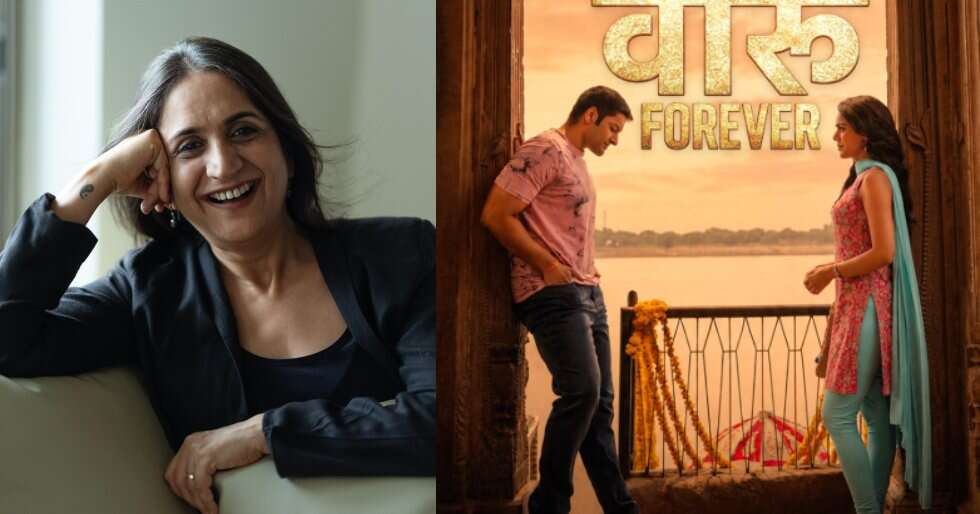
Ginny Diwan has been part of the Mirzapur universe since its first season, writing lyrics that often bring a softer, more emotional layer to the franchise’s violent world. Her work on songs such as Vaaroon helped establish that contrast, while she continued writing for the series through its later seasons. She has also worked across films and series including Baaghi 2, JugJugg Jeeyo, OMG 2 and Jai Mummy Di, among others.
For Mirzapur: The Movie, Diwan reunited with composer Anand Bhaskar for Vaaroon Forever, a new version of the song that expands its emotional canvas beyond what was shown in the series. Sung by Shreya Ghoshal and Romy, the song once again finds tenderness within the world of Mirzapur.
In this conversation with us, Diwan talks about revisiting a song audiences already hold close, the pressure to make lyrics “viral”, the changing conversation around credit and compensation for songwriters, and why she believes AI cannot replicate the human experience behind a lyric.
Excerpts:
I’ve been lucky to be part of Mirzapur since the very first season, so returning for the film felt like coming back to a world I know very well. What has always fascinated me is that beneath all the violence, power and larger-than-life characters, there are very human emotions. That gives me a lot to explore as a lyricist. The film felt like looking at a familiar world but discovering another layer.
What was the brief when you revisited Vaaroon for Vaaroon Forever?
When Anand Bhaskar and I were creating the songs for the first season, Gurmmeet Singh and Mihir Desai briefed us on a situation where Guddu proposes to Sweety and they eventually get married. That’s where Vaaroon was born. Over the years, it received so much love that it became a song people strongly associated with their relationship.
But Vaaroon Forever had to encompass Guddu and Sweety, Golu and Bablu, and even the love Munna feels for Sweety. It had to carry multiple shades and perspectives of love, but the words still had to come from the characters themselves. I wanted it connected to their world, relationships and the way they experience love. As Vaaroon Forever is a duet, the touch of warmth and soulfulness that the distinctive voices of Shreya Ghoshal and Romy brought to the song made it even more endearing, creating a softer, more vulnerable emotional space.
There is some pressure, but it’s the good kind. When people connect deeply with a song, you have to respect that emotional memory. At the same time, you can’t write while worrying about comparisons. You have to understand what made the first song work and find something honest for the new story. For me, that meant staying true to the characters rather than trying to manufacture nostalgia.
Of course, those conversations happen. Sometimes a filmmaker or composer will say, “Can we make this simpler?” or “Can we make the hook more immediate?” The challenge is to simplify without losing the thought or character behind the line. Catchy should never mean irrelevant. When a line comes organically from the character or situation, it has a better chance of staying with people. You can try to engineer a viral line, but you can’t engineer an emotional connection. The catchiness should be a consequence of the thought being right, not the thought itself.
I’ve been fortunate to have worked with a fair share of the truly beautiful, extremely talented and soulful voices of the industry.
But there are so many wonderful voices I haven’t had the opportunity to write for yet: Rekha Bhardwaj, Satinder Sartaaj, Gurdas Maan Saheb, Harshdeep Kaur, Shankar Mahadevan, Shilpa Rao and many more.
Yesteryears were an era when perfection and preparation mattered enormously. There was very little technology to correct or tweak a note, so singers had to bring their finest performance to the microphone, often with very few takes. Perhaps that is why so many songs from that era carry such a distinctive charm and emotional depth.
But if I could turn back the clock, I would have loved to write for Reshma Ji. There was something so raw, earthy and deeply soulful about her voice. It carried a kind of ache that didn’t need to be created or exaggerated; it was simply there. I would have loved to write words that could sit inside that voice and see what emotion it could bring out of them.
Also Read: Exclusive: How Govinda, Madhuri Dixit & Salman Khan Shaped Sparsh Shrivastava’s Bhugol in Dupahiya 2
