

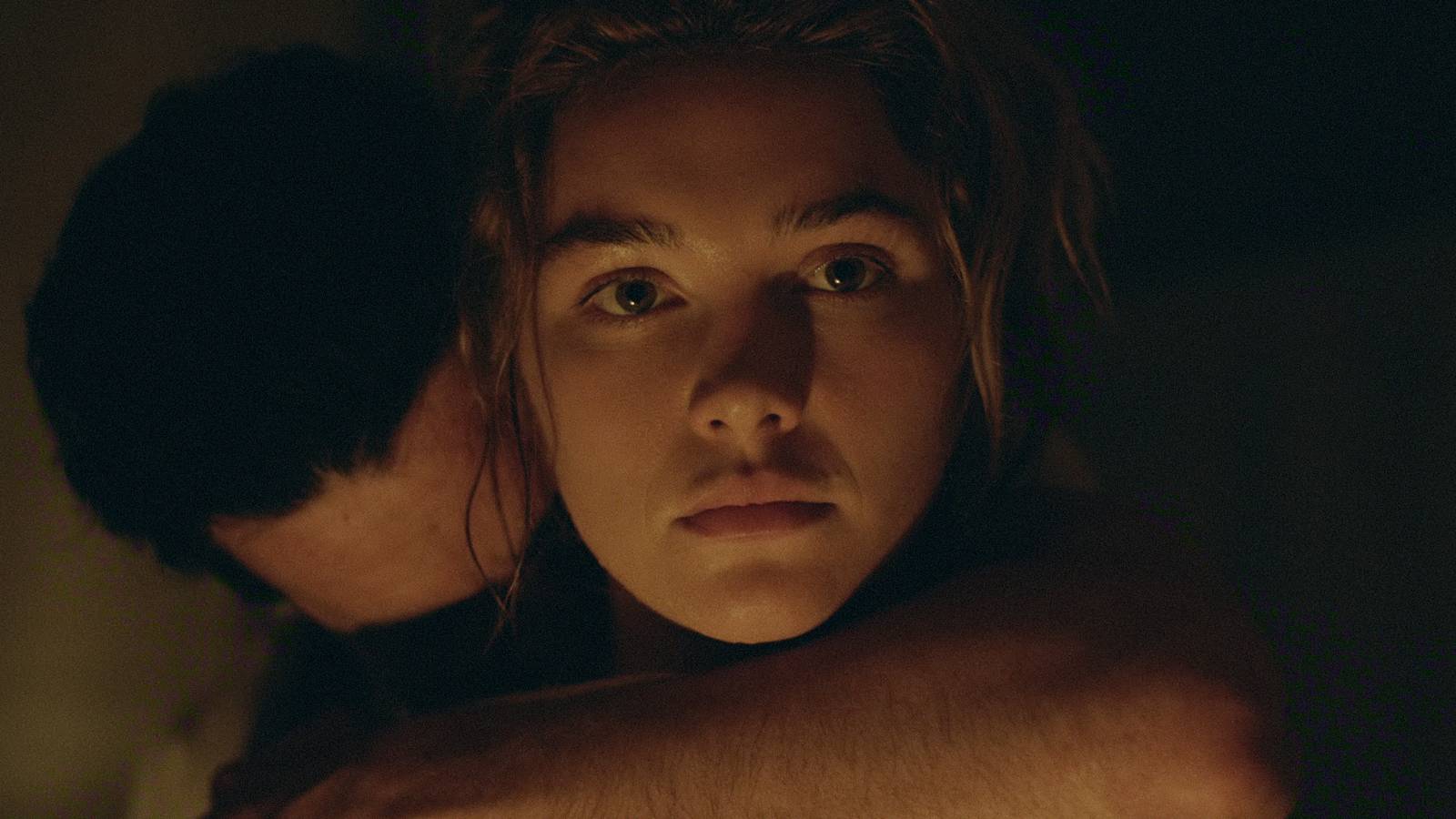
It is no easy feat to adapt a book like East of Eden, the seminal novel by American author John Steinbeck, who has penned such works as The Grapes of Wrath and Of Mice and Men. It is certainly an especially difficult task for creator, showrunner, and writer Zoe Kazan, whose grandfather Elia directed his own adaptation of the book in 1955, a condensed version of Steinbeck’s epic story. Netflix gives Kazan seven episodes to dive into the biblical tale, which takes place primarily in the Salinas Valley in Northern California after setting up its story in New England.
Kazan’s version of East of Eden, while more complete, still eschews some elements of Steinbeck’s novel to streamline the story. The Hamilton family is less prominent and Cathy Ames, portrayed by Florence Pugh, is more of a focus, putting arguably the most compelling elements of the novel center stage. But in its differences, East of Eden struggles to hold the thematic weight of Steinbeck’s text, becoming a paint-by-the-numbers adaptation that suffers from its faithfulness even as its strengths rise above the noise.
Florence Pugh Stuns In East Of Eden
In the logline for the series, Kazan reveals that her version of East of Eden sets out to “[focus] new attention on its indelible antihero” Cathy Ames, with that last word presenting a slight wrinkle in how Cathy is viewed by the show’s creator, and how she views the story as a whole. It is undeniable that Cathy is written by Steinbeck as the embodiment of evil, with the author referring to her as a monster who appears to look normal, someone who sees normality as inherently evil and evil as inherently normal. Somehow, though, it still works – to an extent.
Much of this has to do with Pugh’s performance. Known for her expressiveness, Pugh is more subdued here, wielding her trademark look only when necessary and otherwise presenting as steely, the picture of eerie calm. In Kazan’s East of Eden, Cathy is a woman bucking against the way society treats her, fighting for freedom and using that freedom to wreak havoc in her life as a form of dastardly control.
It’s a modern take on Cathy and one that is sure to divide audiences. It complicates her pure villainy, which was surely the intention of Steinbeck’s original characterization. Making Cathy a victim of circumstance rather than one that wields her power simply because she can robs the character of some agency, an oxymoron that lies underneath the modernization of one of literature’s most complex female characters. One key change to her origin, in particular, will likely draw consternation, but Pugh’s performance somehow seems to both lean into these changes and work against them to give Cathy the well-rounded portrayal she deserves. Kazan and Pugh both clearly care about Cathy, just in very different ways.
It can’t help but feel as if something is missing, especially when Cathy isn’t onscreen…
This is especially true when Pugh is performing opposite Mike Faist as Charles, brother of Adam whose relationship with Cathy is much more turbulent, and therefore much more interesting, than that of hers with Adam. Faist’s limited screen time doesn’t undermine the power of his performance, but it does underscore Christopher Abbott’s weakness as Adam here. Typically a strong performer, Abbott seems a bit lost in the material, partially a fault of Steinbeck’s source material and of Kazan’s own focus on other aspects of the story, some of which feel like diversions rather than intentional additions to an already-sprawling text.
And that’s the crux of the problem with East of Eden. It is so focused on Cathy that it loses sight of its other characters. The show’s standout episodes are all focused on Pugh’s character, with entire hours dedicated to Cathy’s story, including her violent origins as the woman she will become when she meets Charles and Adam Trask, and the woman she creates when she morphs from Cathy into her devastating final form.
East Of Eden Is Still A Powerful Series Despite Its Flaws
For all to do with Cathy, though, East of Eden has so much more to contend with as it moves into the future and beyond its extended prologue, which ends, in part, with Cathy fleeing her circumstances. The birth of twin boys doesn’t do much to tie her down and here is where Kazan’s version catches up with that of her grandfather’s. Unfortunately, the show must rush through this story in two episodes and though it feels more complete than previous adaptations, there is something about East of Eden that feels truncated, both thematically and in its plotting, robbing the series of the full potential of its emotional climax.
Joseph Zada and Joe Anders star as Cal and Aron Trask, the twin sons of Cathy and Adam. Zada gets the meatier role and the future Hunger Games star is engrossing as a counterpart to his mother and paternal uncle. It is in this part that Hoon Lee also shines as Lee, the Trask’s housekeeper and a surrogate father figure to Cal, Aron, and even Adam, who, years later, is still unsure of the place of his own father (Tracy Letts, blustery as always in his portrayal of Cyrus Trask) in his heart and in his legacy.
It’s all too much to be wrapped up in the series’ quickly-plotted final episodes. Even so, East of Eden can be considered a sturdy period piece: the lush costumes, intricate period set design, and layered performances throughout the series’ seven episodes are effective in their absorbing nature, achieving what Kazan set out to do in conveying that this is a meticulous labor of love. Still, it can’t help but feel as if something is missing, especially when Cathy isn’t onscreen.
All episodes of East of Eden are now streaming on Netflix.
- Release Date
-
2026 – 2026-00-00
- Network
-
Netflix
- Directors
-
Garth Davis
- Florence Pugh’s performance as Cathy anchors the series.
- The world of East of Eden is beautifully brought to life in its sets, costumes, and more.
- East of Eden can’t help but feel like a paint-by-the-numbers adaptation, with some choices feeling lifeless.
- Some changes to the text leave little to no impact.
