

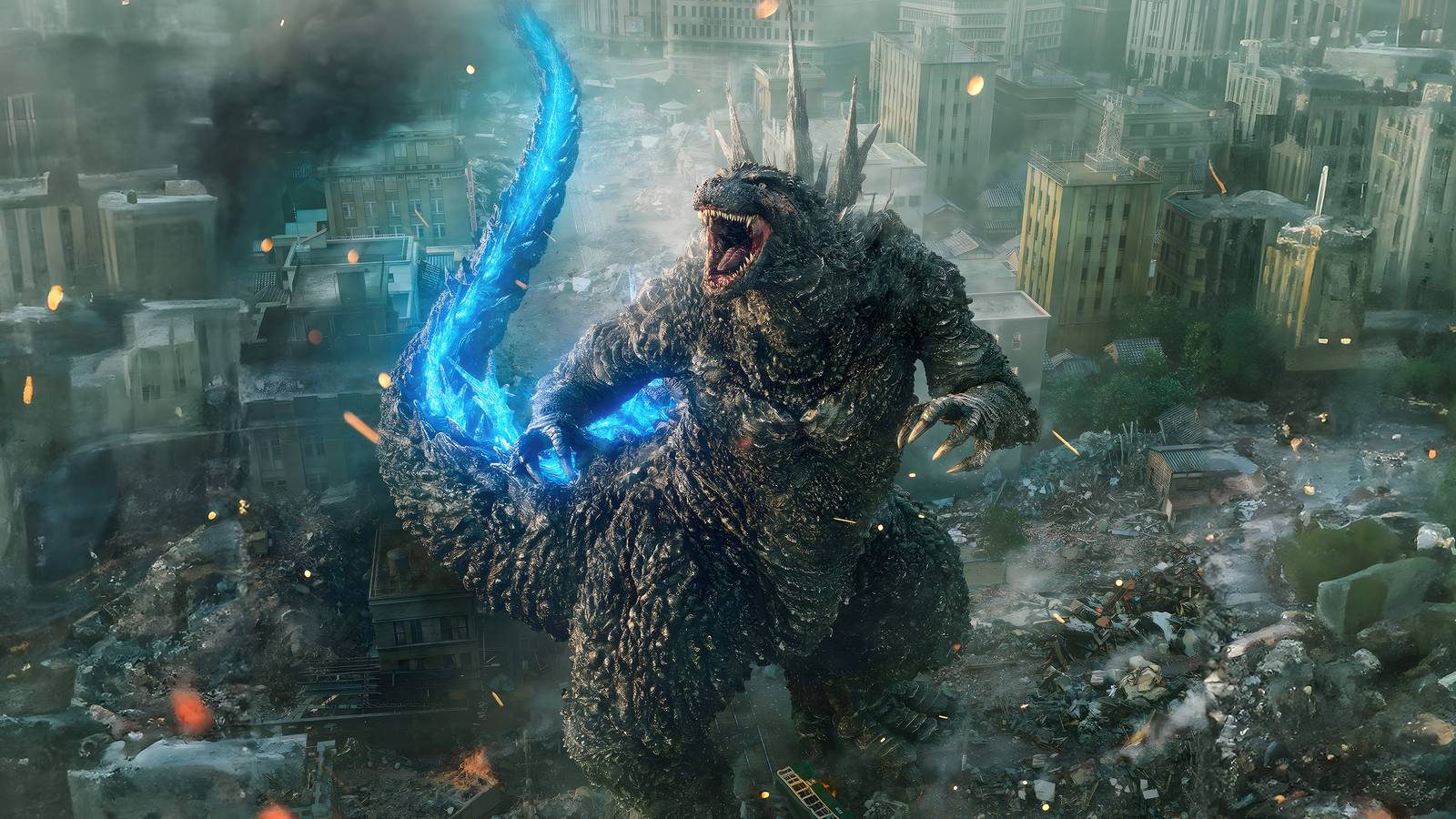
2023 changed the course of the Godzilla franchise for Toho. Takashi Yamazaki’s Godzilla Minus One became one of the best movies with Gojira ever made, was a box office sensation, and even won an Oscar. That level of success allowed a sequel to move forward and build on Godzilla Minus One‘s ending.
That follow-up is Godzilla Minus Zero. Yamazaki returns to write and direct the sequel, and just as the first film’s title raised lots of questions about its true meaning, the same level of discussion surrounds this new chapter.
Godzilla Minus Zero’s Title Teases The State Of Japan After Minus One
At first glance, Godzilla Minus Zero‘s title announcement might not make much sense. After all, -0 is mathematically impossible. Zero can be neither minus nor positive. However, in computing, a negative zero is used for a number that is below 0 but has been rounded up, with the negative sign indicating it is still below zero.
With that in mind, the meaning of the title starts to make more sense. Godzilla Minus One‘s title was chosen to reflect that Japan as a country was already at zero after World War II. Godzilla‘s emergence and the destruction that came made conditions even worse, which is why the film used the -1 idea. Yamazaki said at a 2023 press conference that “Japan… is at zero, and then Godzilla arrives, making the situation even worse and more tragic.” He also said his film is “set even before the time of the original Godzilla,” so in that sense it is also a “minus one.”
The sequel’s decision to use Minus Zero could reflect how Japan is recovering from the events of the first film. If Japan was at “minus one” after Godzilla’s initial attack, applying the same logic to “minus zero” suggests that the country is in a better state this time around.
However, Japan’s status “improving” in this way is still not all that great. The country is still in a similar spot as it was after World War II, and the negative zero use suggests that it is still somewhat worse than where things were before. The state of things could still be bad overall, even if it’s not quite as poor as before.
It’s not confirmed how much time passes between Minus One and Minus Zero either. If several years have passed and we’re now in the 1950s, Japan’s condition still being seen as below the country’s lowest point in real life would illustrate just how far back the events of the first film set its recovery. Godzilla Minus Zero picks up in 1949, two years after the events of Godzilla Minus One, according to GKIDS. The film continues the story of the Shikishima family as they face an all-new calamity.
Godzilla Minus Zero’s Title Could Be A Ghidorah Tease Too

Beyond the ramifications on Japan, there’s a possibility that Godzilla Minus Zero is teasing Ghidorah’s introduction through the title. Yamazaki previously suggested that a Minus One sequel would include other kaijus, and it’d make sense for the King of the Monsters to fight one this time around.
There are no shortage of Toho monsters and classic Godzilla villains that Minus One‘s sequel could use, but the title cleverly points to Ghidorah. The three-headed dragon-like alien creature has had many different aliases in the 60-plus years since he debuted. One of the names Ghidorah has been called is Monster Zero. In Invasion of Astro-Monster, the creature referred to as “Monster Zero” is actually King Ghidorah, the three-headed space dragon. The film was released theatrically in the United States as Monster Zero, and it’s also been known as Godzilla Vs. Monster Zero on some home video releases.
Using Minus Zero would then give the title multiple meanings. In addition to setting up the state of things when the sequel takes place, it becomes a way for audiences to start prepping for the arrival of one of Toho’s most iconic villains.
King Ghidorah was introduced in Toho’s 1964 feature Ghidorah, the Three-Headed Monster. The creature is always seen with his trademark three heads, and originally was introduced as an alien meant to destroy Earth. Subsequent films have changed his origin to be from the future, an ancient Japanese guardian, and an alternate dimension god.
This would be the 12th movie appearance for Ghidorah overall. The Monsterverse was the last to use him, as he was the main villain of Godzilla: King of the Monsters in 2019.
Godzilla Minus Zero including Ghidorah as the villain would allow the long-standing cinematic rivalry to continue. It’d also give the movie another major Toho monster, ensuring that the scale would dramatically increase as Godzilla and Monster Zero fought once more.
If Godzilla Minus Zero does include the dragon-like villain, it’ll be fascinating to see how the film handles its backstory. The traditional extraterrestrial origin may feel a bit out of place, depending on how much the sequel continues to lean into the real-life hardships of humanity.
In any case, the title for Minus One‘s sequel creates room for many conversations and points of view. As more details on Godzilla Minus Zero become known, additional meanings could arise and the current readings can be confirmed.
Godzilla Minus Zero Release Date, IMAX And Cast

Toho released Godzilla Minus Zero in Japan on Tuesday, November 3, 2026. GKIDS will launch the wide North American release on Friday, November 6, following IMAX Early Access screenings on November 3. It’s the first Japanese production Filmed For IMAX, shot with high-definition digital cameras certified by IMAX. Takashi Yamazaki returns as director, screenwriter, and VFX lead after Godzilla Minus One.
Hidetaka Yoshioka is back as Kenji Noda, who now battles the new threat as director of the Disaster Response Bureau. Yuki Yamada returns as Shiro Mizushima and Kuranosuke Sasaki as Seiji Akitsu, captain of the Shinseimaru. Sakura Ando reprises Sumiko Ota, who now runs a local orphanage, and Kisuke Iida returns as Akio Itagaki. Masami Nagasawa joins as Makoto Aoyama, a genius weather forecaster assigned to the Disaster Response Bureau. Jun Kunimura plays Dr. Ogata, and Kou Maehara plays Akira Hagiwara, Professor Murakami’s assistant.

- Release Date
-
November 6, 2026
- Runtime
-
135 minutes
- Director
-
Takashi Yamazaki
-

Ryunosuke Kamiki
Koichi Shikishima
-
Minami Hamabe
Noriko Oishi
-
Min Tanaka
Kanji Murakami
-
Hidetaka Yoshioka
Kenji Noda
