

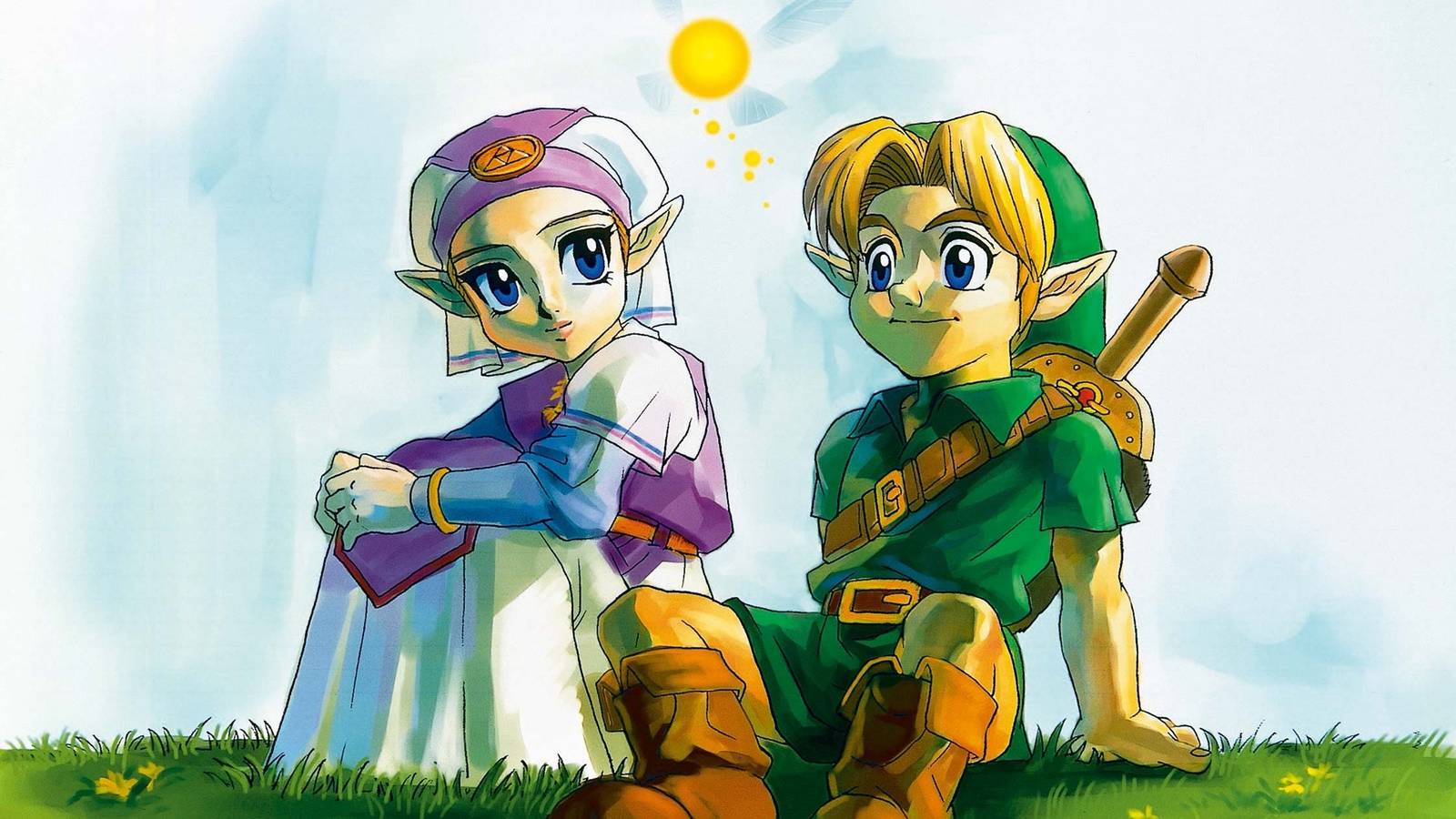
The Legend of Zelda is steeped in hallmarks and history, but it has nevertheless evolved significantly in its 40-year existence. With The Legend of Zelda: Ocarina of Time returning in a remake for the Nintendo Switch 2, I’m worried that some of the series’ more recent innovations will ruin particular aspects of the classic game, one quest in especially.
Ocarina of Time codified the series’ 3D formula that would be followed for decades, and while the 1998 original still holds up fairly well, it is quite dated. It’s quaint by modern standards – a result of technical limitations – and has a very old-school approach to quests and adventuring. Zelda‘s framework was refined all the way through Skyward Sword and A Link Between Worlds, but Breath of the Wild introduced a key feature that could potentially undermine a fundamental design principle in Ocarina of Time.
New Zelda Games Have Quest Markers
Breath of the Wild was the series’ first truly open-world game, and adopted staples of modern adventure titles: a quest log and markers. These returned in Tears of the Kingdom, of course, but were also a feature in Echoes of Wisdom, the series’ newest mainline entry. To be sure, a quest log is necessary in all three games. People throughout Hyrule have all sorts of tasks they recruit Link and Zelda to help with, and it would be impossible to remember all your in-progress quests without a list keeping track.
Quest markers can often feel like they streamline games enough to make an open world effectively pointless, but Nintendo has used them quite well so far. In BOTW and TOTK especially, the emphasis is on exploration, and their quest markers guide you in certain directions, but you’re often waylaid or required to do some critical thinking anyway. We don’t yet have confirmation one way or the other if the Ocarina remake’s gameplay changes will include quest markers, but I’m still concerned about the possibility.
Quest Markers Would Ruin Classic Sequences Like The Biggoron’s Sword Trading Quest

Perhaps the most iconic side quest in Ocarina of Time is the trading sequence to get Biggoron’s Sword. It’s more or less a traversal puzzle; the most difficult sections require you to get from one place to another in under a certain amount of time. But it also shines because of a few objectives with intentionally vague instructions.
Take one of the earlier trades, for instance, in which you get a blue-feathered Cucco named Cojiro from the Cucco Lady (Nintendo, please just give this woman a name in the remake). She tells Link that Cojiro hasn’t crowed since her brother, Cojiro’s former owner, disappeared from Kakariko Village – an event that transpired while Link was locked in the Sacred Realm for seven years after pulling the Master Sword from its pedestal. To continue the quest, you have to take Cojiro to the Cucco Lady’s brother, another nameless character referred to as the Master Craftsman’s Son.
Her brother’s identity isn’t made clear in the game, though. You can talk to him when Link is a child. He’s a disillusioned youth who lives a solitary life, only coming out at night to sit under a tree near the Kakariko Village gate. The Master Craftsman stands on that spot during the day, and will complain to Link about his son.
Ocarina of Time doesn’t explicitly tell you who Cojiro’s owner was, nor does it tell you where to find him (he’s run away to the Lost Woods after Ganondorf’s coup), but it does provide enough context for you to figure it out. It’s exceptionally obtuse by modern quest design standards, akin to the frustrating experience of completing NPC storylines in Elden Ring, but modernizing such things would undo Ocarina of Time‘s foundational design.
Ocarina of Time is a tale of two Hyrules. One is the kingdom thriving during Link’s youth, blissfully removed from the Hyrulean Civil War years prior, while the other is the calamitous result of Ganondorf’s newfound rule seven years later. Getting Biggoron’s Sword – without just looking up a guide – is a test of how thoroughly you came to understand both versions of Hyrule.
If you poke around Kakariko Village, you’ll easily piece together who the Craftsman’s son is, and you’re likely to figure out that he’s also the brother of the Cucco Lady. There’s still no pointed indication of where to find him post-time skip, but it’s not hard to guess where a loner might retreat to. Up Death Mountain Trail perhaps, or maybe to Lake Hylia on the other side of Hyrule Field? But really, he’s in Ocarina‘s most lonely place, the Lost Woods, and you’re likely to stumble upon him if you continue your due diligence in exploring the two Hyrules.
A quest marker would undo all the bespoke world-building that makes the Biggoron’s Sword quest line so memorable. You’d know exactly where to take Cojiro; it wouldn’t be rewarding to figure out that the Poacher’s Saw needs to go to the Master Craftsman in Gerudo Valley; even finding Talon to get the quest underway would be pointlessly simple. The quest’s timed sections are similar tests of how thoroughly you’ve explored – do you remember exactly where the laboratory near Lake Hylia is, and can you get there from Zora’s Domain in under three minutes?
I’d like to think Nintendo knows what makes Ocarina of Time tick; Eiji Aonuma and Shigeru Miyamoto are still in charge, after all. But I’m wary that the remake may be taken as a misguided opportunity to “fix” Ocarina of Time. Miyamoto is on the record discussing the design shortcomings of Navi, Link’s fairy companion, who is Ocarina‘s de facto quest direction system, a character designed to help players navigate the novelty of a 3D adventure game in 1998.
The obvious replacement would be quest markers, or a log that very pointedly hints at where you need to go for certain tasks. But then there would be no need to engage with Hyrule as it was originally designed. Ocarina of Time feels like a big game, but it’s just a clever illusion. The square footage of its map is comparatively tiny. Getting to know Hyrule, both before and after Ganondorf’s rise to power, is crucial to the experience.
Link begins the game as a boy without a fairy, and is quickly thrust into a world he doesn’t know. By extension, it’s a clever bit of ludonarrative harmony for the player, who has no recourse but to run and roll around Hyrule, talking to everyone they come across and learning each location’s idiosyncrasies. Adding quest markers to the remake of The Legend of Zelda: Ocarina of Time could remove the need to get familiar with the very kingdom Link is supposed to save.

- Released
-
2026
- Developer(s)
-
Nintendo
- Publisher(s)
-
Nintendo
- Number of Players
-
Single-player
