

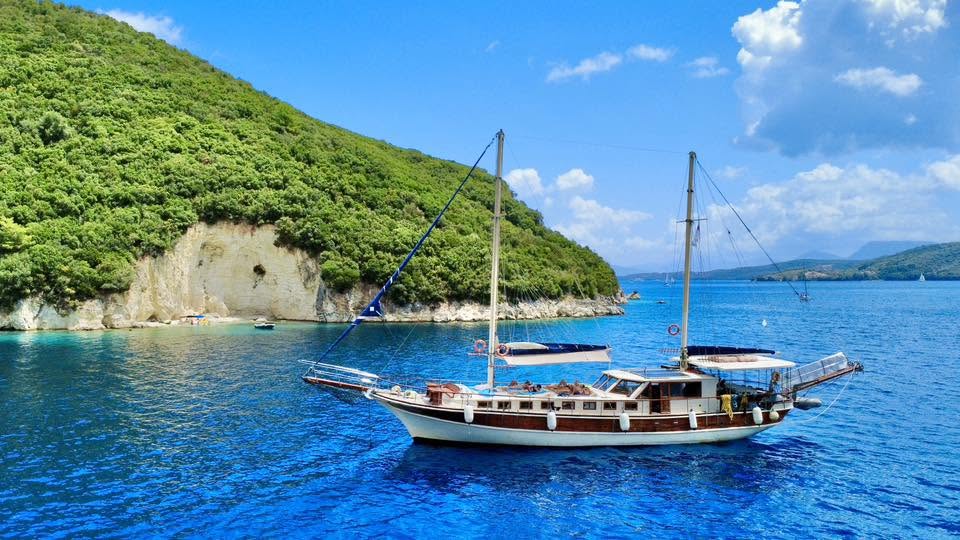
Choose the Ionian if you want calmer water, short hops between green islands and an easy first sailing holiday. Choose the Aegean if you want the famous island names, ancient history and a more open-sea feel, and you are happy to plan around the wind. Both are brilliant. The right one depends on your group, your tolerance for wind and what you want your days to feel like.
Here is how Ionian vs Aegean sailing compares in practice, including the one thing most guides skip: the Aegean is really three different sailing areas. (New to gulet holidays? Our guide to what to expect on a gulet cruise in Greece covers cabins, food and a normal day on board.)
Compare the Routes With Sail in Greece
Sail in Greece, the operator behind this guide, runs weekly gulet cruises in all three areas compared here: the Ionian from Corfu and Zante, the Cyclades from Mykonos, and the Dodecanese from Kos and Rhodes.
Good to know
Week-long cruises with a crew who sail and cook, so no sailing experience is needed
The Corfu week starts from £763 per person for June 2027, checked October 2026
Port fees and cruise tax are paid on top, so check the total for your route
Dedicated 18 to 39 departures run in the Ionian
Check dates and prices for all routes →
This section contains partner links. If you book through them, we may earn a commission at no extra cost to you. We only feature partners whose services we believe add genuine value for travelers.
“The Aegean” is really three different trips
When people say Aegean they usually mean one of three areas, and they feel quite different:
- The Cyclades (Mykonos, Syros, Kea, Kythnos and the islands around them): the classic white-and-blue postcard islands, lively harbors and the strongest summer winds.
- The Dodecanese (Kos, Rhodes, Symi, Patmos, Leros, Kalymnos, Tilos and Chalki): the south-east Aegean, close to the Turkish coast, with castles, monasteries and quiet fishing villages.
- The Saronic and nearby islands near Athens: short sails from the capital. Our 7-day Saronic Gulf itinerary shows how a week there looks.
The Ionian, on the west side of Greece, is more consistent. It runs from Corfu in the north through Paxos, Lefkada, Ithaca and Kefalonia down to Zante.
| Ionian | Aegean (Cyclades and Dodecanese) | |
|---|---|---|
| Landscape | Green, wooded, mountainous, turquoise coves | Drier, rockier, white villages, big skies |
| Wind in summer | Gentle afternoon breeze most days | Stronger, especially the July and August meltemi in the Cyclades |
| Distances | Short hops, islands close together | Often longer open-water passages, especially in the Cyclades |
| Feel | Relaxed, quiet, nature-led | Livelier harbors, more history and nightlife |
| First-timer friendly | Very | Yes, with the right route and season |
| Famous names | Corfu, Paxos, Zante, Kefalonia | Mykonos, Rhodes, Patmos |
Wind and sea: the real difference
This is what most people actually want to know.
Ionian. The main summer wind is the maistro, a mild north-westerly. It typically starts around late morning, builds through the afternoon at roughly force 3 to 5 on the Beaufort scale and fades by early evening, leaving calm nights at anchor. It runs from about late May to late September.
Aegean. The summer wind is the meltemi, a strong, dry northerly that is most common in July and August. It usually blows around force 6 to 7 when it is up, sometimes more, and tends to strengthen in the heat of the afternoon and ease overnight. It can last a few days at a time. The Cyclades feel it most. Among close-set islands, which give shelter, it is easier to manage.
On a gulet, this matters in a practical way. The captain plans the route around the weather, so a windy day usually means a different anchorage or a shorter hop. In the Ionian you will seldom need to change plans for the wind, while in the Aegean in peak summer you should be a little flexible.
Distances and the shape of a day
Short distances mean more time swimming and less time moving.
In the Ionian, islands sit close together and the larger ones shelter the smaller ones, so most days are a few hours of cruising, a long swim stop and an evening in a harbor village. In the Cyclades, the gaps between islands can be longer and more exposed. In the Dodecanese, the island chain is dense again, so hops are short.
Here is how that looks in three real weekly routes:
| Area | Route (8 days, 7 nights, Saturday to Saturday) | A typical day |
|---|---|---|
| Ionian | Zante, Kefalonia (Antisamos, Fiskardo), Lefkada and Nidri, Meganisi, Ithaca, back to Zante | Swim at a bay, wander a harbor village, olive oil tasting, Skorpios island view, a captain’s dinner |
| Dodecanese | Kos, Pserimos, Kalymnos, Leros, Lipsi, Patmos, Levitha, back to Kos | Swim stop at a small island, then a castle, a monastery or the Cave of the Apocalypse on Patmos |
| Cyclades | Salamina (Athens), Kea, Syros, Mykonos, Kythnos, back to Salamina | Swim off Rhenia, a day around Mykonos, a beach stop at Kolona on Kythnos |
(There is also an 8-day Ionian route from Corfu through Sivota, Parga, Antipaxos and Paxos, and a Rhodes route through Symi, Tilos and Chalki.)
Scenery and character
Ionian. Think green hills, cypress and olive groves, caves and turquoise coves. Highlights include the Blue Lagoon at Sivota, the Venetian castle at Parga, the beaches of Antipaxos, and the Blue Caves of Paxos. It feels natural and unhurried.
Cyclades. White-washed villages, windmills, bars with sunset views and island towns that stay awake late. Mykonos is the famous name and is lively, but the smaller islands on the route are much quieter.
Dodecanese. More history per square mile: Rhodes’ medieval old town, Patmos with its monastery and the Cave of the Apocalypse (both UNESCO World Heritage), the castle at Leros. Quieter harbors and a very local feel.
Which suits your group
Couples. The Ionian for a romantic, calm, scenic week, the Dodecanese if you want culture with your swimming. The Cyclades if sunsets, cocktails and Mykonos are the point.
Friends traveling together. Any. Choose by vibe: the Ionian for relaxed, the Cyclades for lively. If you are in the 18 to 39 range and want a social, party-friendly week, there are dedicated 18 to 39 cruises in the Ionian on routes between Corfu, Lefkada and Zante.
Solo travelers. The Ionian is an easy starting point because the days are short and sociable, and many solo guests travel on gulets. Expect a single supplement if you want a cabin to yourself.
First-time gulet guests. Start in the Ionian or the Dodecanese. They have the shortest hops and the calmest conditions.
Anyone prone to seasickness. The Ionian first. If you choose the Aegean, pick a shoulder-season week (May, June or September) and ask the operator how long the open-water legs are.
Culture lovers. The Dodecanese, then the Cyclades.
Beach and swimming lovers. The Ionian has more sheltered coves, but every area has great swim stops.
Does your experience level matter?
On a gulet, you are not sailing the boat, so “experience” is mostly about comfort:
- First time on a boat: Ionian. Gentle conditions, short distances.
- Done a gulet cruise before and want something different: try the Dodecanese or the Cyclades.
- Comfortable with a bit of motion: the Aegean is fine in any season, and the meltemi is part of the character.
- Experienced sailors who want to sail themselves: the Aegean is a more demanding area, and the Cyclades in peak summer are windy. That calls for a skippered or bareboat charter.
Does the season change the answer?
Yes. The Aegean is at its windiest in July and August, so if those are your only dates and you want calm, favour the Ionian. In May, June and September the Aegean is far gentler and often quieter. For more island ideas, browse our Greece travel guides.
Questions to ask before you book
1. Which sailing area is this route in, exactly (Ionian, Cyclades, Dodecanese)?
2. How long are the longest open-water legs?
3. What happens on a windy day: a different route or a delay?
4. Who usually books this departure (couples, solos, friends, 18 to 39)?
5. What is included, and are port fees and cruise tax in the price shown?
Frequently Asked Questions
Which airport do I fly into for a gulet cruise in Greece?
It depends on the route. Ionian weeks start in Corfu or Zante, which both have their own airports, and Dodecanese routes start in Kos or Rhodes, which do too. The Cyclades route starts at Salamina near Athens, so you fly into Athens and transfer to the port.
How much does a week on a gulet in Greece cost?
On the Ionian route from Corfu, prices start at £763 per person for a June 2027 week (checked October 2026). Port fees and cruise tax are paid on top, and drinks, dinners ashore and tips are extra. Prices vary by route, boat class and week, so compare the total for your dates.
Do I need sailing experience for an Ionian or Aegean gulet cruise?
No. The captain and crew sail the boat and plan the route around the wind, so you only need to be comfortable stepping on and off a boat and swimming in open water. If you want to sail yourself, a skippered or bareboat charter is the better fit.
Which months are calmest for sailing in the Aegean?
May, June and September. The meltemi is strongest in July and August, while in the shoulder months the wind is usually lighter and the islands are quieter. If you can only travel in high summer and want calm water, the Ionian is the safer bet.
